A few days ago, I lit the fuse on a working prototype of a government service. No team, no procurement cycle, no waiting for approval. Just me, a few prompts, and a handful of AI tools. And honestly? Fireworks.
Vibe coding (or vibecoding) is an approach to producing software by using artificial intelligence (AI), where a person describes a problem in a few sentences as a prompt to a large language model (LLM) tuned for coding. The LLM generates software based on the description, shifting the programmer’s role from manual coding to guiding, testing, and refining the AI-generated source code.
I’m not new to what’s now being called vibe coding. Over the last year ChatGPT has helped me to bring a few random ideas to life1. Last weekend I thought I’d see what Codex CLI could do and I was again blown away. I mentioned this at work and in the conversation that followed we mused on whether some of the frustrations we’d been feeling could be shifted by trying the same thing there.
So I sat down with a laptop, some product instinct, and a handful of different AI tools. I wanted to see whether we could finally conjure the ‘fireworks’ we’d been waiting weeks to set off. I started with ChatGPT and the scale of the task was a bit intimidating. But then I remembered about Firebase and in minutes had something to show off. As I did, another colleague responded by asking if I’d seen Stitch, and another colleague said I should check out Jules.
And once I discovered Jules, that was when things got really interesting. Very quickly I had something live. Not a sketch or simulation, but something real. It’s up and running on Render (and I’d love to give you the link but I probably shouldn’t let it escape into the wild; at least not yet).
Obviously it’s just a prototype. But that also seems to do it a disservice. What is true is that it absolutely appears to do the job we had in mind. No engineers. No designers. Just me, some prompts and decisions, and it works, and it works in a way that will absolutely elicit the right sort of oohs and aahs.
I suppose I ought to make one small confession. I really shouldn’t have done any of this. Inside the department, everything except Copilot is blocked (and even then you only get Copilot on a Windows machine, not a Mac). Which means this burst of delivery joy has happened off network, off platform, and probably against better judgment. But that, too, is part of the problem. When the path of least resistance leads outside the system, it’s the system that needs fixing, not the people finding their way around it. Well, I would say that wouldn’t I?
Now, for our purposes as a team this exercise might be the perfect fireworks but more broadly for government, what are the repercussions?
I’m going to call it: Jules and Codex earn their hype.
Unless otherwise indicated or an obvious screenshot, the images were generated by ChatGPT.
David McCandless, of Information is Beautiful, suggested that instead of thinking about data like oil, we should rather think of it like soil. Data is a fertile environment from which good things might happen.
But just like soil, it is something you have to nurture and care for if you want it to give you a good return.
And this is where we start our second section – if we’re in roles with responsibility for building a data-driven public sector then we need to think about our job in terms of farming. We need to be mindful that when it comes to data our job is to make good soil and nurture data-driven ways of working.
Too often, digital is treated as a specialist brick laid by others. But real transformation happens when digital becomes the mortar and binds teams, cultures, and missions together. This framework argues that while investment in digital, data and technology professions and leadership are essentials, the key to unlocking sustainable, whole of government transformation is making digital everyone’s business.
This framework emerged from work led by the OECD’s Digital Government and Data Unit. I had the privilege of co-authoring the paper alongside Lucia Chauvet, supported by the Working Party of Senior Digital Government Officials (E-Leaders) and its Thematic Group on Digital Talent and Skills. It builds on years of OECD collaboration in this space — drawing lessons from country reviews, global case studies, and shared experience from digital leaders across the world.
Since publication, the framework has been embedded in OECD Digital Government Reviews and country support work. It’s designed to be actionable — not just a diagnostic tool, but a map for reform.
One example: we used it as the basis for work with the Government of Tunisia, which led to a resource called Understanding Digital Government — a companion website (formerly at understanding-digital-government.com) in French and Arabic. We worked with Public Digital to design a set of training materials that would help public servants engage with and learn about the five digital government user skills. Sadly, that site is no longer live. I had always hoped we’d be able to translate those materials into every OECD language, but like many good ideas, that ambition outpaced our capacity.
We also used that Tunisian project as an opportunity to work with the School of Good Services to provide training to the most senior decision makers across the Tunisian local government sector.
Digital, data and technology are transforming how we live, and also how we work. This is as true in the public sector as anywhere else.
Governments that want to deliver in a digital world need more than just technical upgrades; they need capable, confident, and collaborative teams. That means:
Creating a working environment that encourages transformation,
Defining and nurturing the skills that matter,
And building the systems to attract, grow, and retain a digital-capable public workforce.
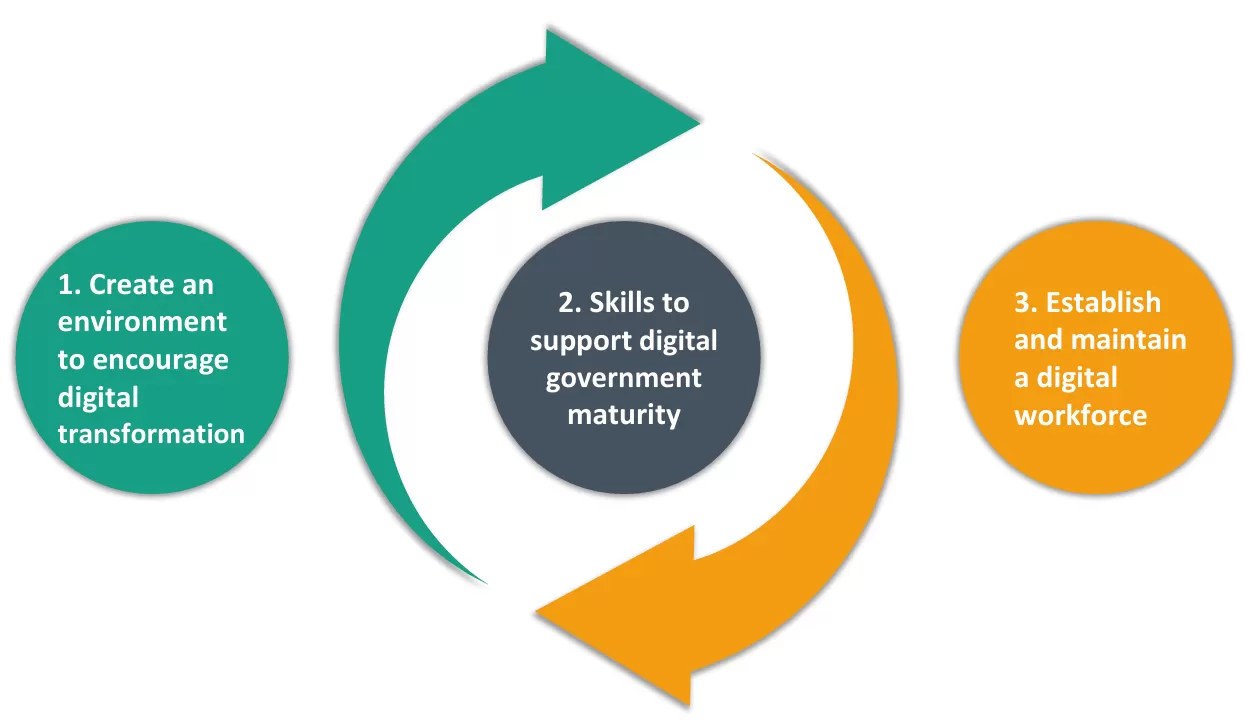
This paper presents the OECD’s framework for digital talent and skills, structured around those three imperatives, each grounded in real-world examples and practices from member and partner countries.
The Three Pillars of the Framework
Pillar 1: Create an environment to encourage digital transformation
Governments need more than strategies — they need workplaces where digital ways of working can thrive. That means:
Digital leadership that’s visible, user-centred, and empowering;
Organisational structures that enable multidisciplinary work and reduce hierarchy;
A learning culture where experimentation is safe and valued;
Tools and ways of working that support agility and delivery.
Pillar 2: Skills to support digital government maturity
Skills aren’t just about technical roles. The framework identifies that countries need to be mindful about the foundational “21st century skills” needed across society for people to thrive in the digital era and then identifies four categories of capability that rest on top:
User skills — digital basics for every public servant
Professional skills — the know-how for delivering digital services
Leadership skills — the ability to model and enable transformation
Each of those areas covers the detail needed to achieve a long-lasting and sustainable transformation and is grounded on raised expectations for all members of society and providing them with levels of digital competency that mean they fully thrive in our Internet-enabled world.
This has implications for government. And a critical observation in the framework is that digital government should not solely be the preserve of those in the digital, data and technology professions. Central to the framework is an expectation that governments should pursue a new baseline expectation for public sector workers to acquire a grounding in five core skills:
Recognising the potential of digital for transformation1
Pillar 3: Establish and maintain a digital workforce
It isn’t possible for governments to click their fingers and swap their existing workforce for a ‘digital’ one. And nor should they want to.
The answer to digital transformation is about having a workforce that is digital. There are important professions and career paths that need to be established but more importantly is creating an ongoing process that can enhance and equip everyone in the public sector to contribute to digital transformation.
This pillar focuses on how governments can:
Attract digital talent through flexible recruitment and employer branding;
Retain people by investing in culture, career progression, and equity;
Support growth through structured development, mentoring, and learning opportunities;
Build the systems to allocate skills effectively across teams and priorities.
The blurb
The rapid pace of technological advance and associated potential for the use of data have not only changed the way people live but also the way people work. This digital disruption hits all sectors, including the public sector, and this working paper emphasises pathways for developing a public sector workforce with the necessary skills to achieve successful digital transformation. It presents the OECD Framework for Digital Talent and Skills in the Public Sector, which highlights the need to create the right working environment, secure the right skills, and evolve the right workforce to support a progression from e-government to digital government.
When a public servant recognises the potential for digital transformation they: * identify, describe and analyse practical examples of digital transformation; * look at the status quo of existing processes and identify opportunities for digital transformation; * have a growing network of digital government practitioners to turn to for advice and challenge; * understand, and can challenge, whether new activity involving technology is consistent with wider strategic activity; * oversee and develop new digital, data or technology activity in ways that complement broader strategic activities * can ask relevant, informed, and challenging questions when they have oversight responsibility for digital, data and technology activity ↩︎
When a public servant understands users and their needs they: * champion and explain the value of user research and participate as part of user research exercises; * can identify the users affected by their area of work, and define the user needs their work meets; * can identify where their work interacts with, receives from, or hands off, to another part of government and recognises the importance of an end to end understanding of the user’s journey; * recognise the different channels and modalities involved in the provision of a service and can map the user’s journey, including associated internal steps; * understand the importance of tackling the digital divide and the priority, roadmap and strategy for accessibility, national connectivity and increasing 21st century skills in society ↩︎
When a public servant collaborates openly for iterative delivery they: * can explain the benefits of ‘working in the open’ and argue positively for an open by default approach * can implement participatory approaches to their area of work to genuinely include their users * understand the value of diverse, multi-disciplinary teams and expect to involve policy, delivery and operational colleagues to ensure a fully-rounded perspective on any given topic * can explain the benefits of an iterative approach to delivery * understand different phases of delivery (e.g., Discovery, Alpha, Beta, Live) and are clear about the benefits of researching, prototyping, testing and learning on an ongoing basis; * have an understanding of open source code and the community-based processes that support them * know where to find, and appraise, the suitability of common standards, components and patterns ↩︎
When a public servant is trustworthy in their use of data and technology they: * understand their responsibilities in the workplace around information security and data handling or processing * are confident in terms of digital security and clear about password policies * understand the legal requirements on them as individuals in terms of their handling of data to protect the privacy of citizens * are comfortable considering the ethical dimensions associated with the use of digital technologies or data, including knowledge of any relevant instruments such as Good Practice Principles * understand the support and activities associated with maintaining a reliable service * ensure that contracts with third party suppliers are consistent with the digital government agenda ↩︎
When a public servant knows about data-driven government they: * are aware of the individuals or organisations that are responsible for the data agenda * understand the priority, roadmap and strategy for taking the steps to establish a data-driven public sector * are familiar with the governance arrangements for access to and sharing of data * are confident in their legal and ethical obligations for the treatment of data * recognise opportunities for how interoperability, the Once Only Principle and access to transactional data can support the better design of services * adopt an empirical approach to the use of data for generating public value in terms of Anticipating and planning, Delivery, and Evaluation and Monitoring * understand the value of Open Government Data to government, and the wider ecosystem. ↩︎
So much of the current public discourse leaves me with a heavy heart, and Robert Jenrick’s recent interview with The Spectator is another depressing contribution. It might be worth reading… Read more: What if Robert Jenrick hung out with Jesus?
Sometimes the best ideas are under our noses, just waiting to be noticed. And I think GovWifi is one such idea. For years now, civil servants, contractors and visitors have… Read more: Under our noses; in the air around us
To provide the best experiences, we use technologies like cookies to store and/or access device information. Consenting to these technologies will allow us to process data such as browsing behavior or unique IDs on this site. Not consenting or withdrawing consent, may adversely affect certain features and functions.
Functional
Always active
The technical storage or access is strictly necessary for the legitimate purpose of enabling the use of a specific service explicitly requested by the subscriber or user, or for the sole purpose of carrying out the transmission of a communication over an electronic communications network.
Preferences
The technical storage or access is necessary for the legitimate purpose of storing preferences that are not requested by the subscriber or user.
Statistics
The technical storage or access that is used exclusively for statistical purposes.The technical storage or access that is used exclusively for anonymous statistical purposes. Without a subpoena, voluntary compliance on the part of your Internet Service Provider, or additional records from a third party, information stored or retrieved for this purpose alone cannot usually be used to identify you.
Marketing
The technical storage or access is required to create user profiles to send advertising, or to track the user on a website or across several websites for similar marketing purposes.