Rachel Reeves has been quick to tell us that UK public finances are in their worst state since World War Two. As she pores over the bank statements to identify a subscription or two to cancel she might pause at the £900,0001 we send each month to the OECD and ask what are we getting for that money.2
I hope she and the Cabinet get a handle on that a bit more quickly than their predecessors. In the summer of 2023 the UK Foreign Secretary was in Paris, chairing the OECD’s annual meeting of ministers. He gave a speech that basically said “Before this week I didn’t appreciate the breadth and value of the OECD”. Arguably, he was just praising the organisation with niceties but then again, the ministerial musical chairs of the last decade means it’s not wholly surprising if the value and scope of the OECD got a bit lost.
It’s easily done.
OECD data does crop up from time to time but neither UK politicians or UK media seem to pay too much attention to its work. Just this week the OECD published the latest edition of its Trust Survey. In Ireland there was a ministerial press release and some press coverage but in the UK, nothing. And yet there’s a huge amount to unpack from what it says (and what it doesn’t) including the headline that only 2 of the surveyed countries have lower levels of trust in national government than the UK3.
In the course of developing this Recommendation I’m particularly proud of how we brought in a wide range of perspectives in the development. We started with an attempt at user research by sitting down with digital identity teams from across the OECD, we workshopped through early iterations of the recommendations, convened an external group of experts and then used the Observatory of Public Sector Innovation’s dedicated consultation platform to open up the earlier draft for public comment.
Honestly it was a bit of a fight to do all of these extra, but value adding, steps (and frustratingly subsequent exercises on these lines have regressed to a PDF and an email address) but this wasn’t cosmetic. The feedback loop with civil society, experts and ordinary citizens mattered. And you can see the difference: between the draft consulted on and the final version endorsed by Ministers, the text gained sharper language on inclusion, stronger recognition of user control, clearer obligations on oversight and redress, and a deeper emphasis on cross-border trust.
Digital identity is critical public infrastructure.
This Recommendation commits OECD countries to govern digital identity not as a narrow technical scheme but as a core enabler of trust, inclusion and international interoperability. It sets out a principles-based framework under three pillars: user-centred inclusion, robust governance, and cross-border portability.
Why it matters
Identity verification has always been essential but in the digital age, physical cards and passports alone are not enough. Digital identity underpins access to services, participation in the economy and cross-border transactions. Yet it is also risky: touching privacy, security, liability, inclusion and trust. That makes governance fundamental. The Recommendation’s narrative frames digital identity as critical digital public infrastructure, on a par with connectivity, payments and registries.
What the Recommendation covers
The Recommendation is structured around three main pillars:
User-centred and inclusive systems
Apply service design methods to make digital identity effective and usable.
Prioritise accessibility and affordability; preserve non-digital alternatives.
Encourage privacy-preserving and consent-based solutions, with user control over attributes and credentials.
Provide support and skills-building for those excluded or struggling to access services.
Monitor, evaluate and publish performance to ensure accountability.
Strengthening governance
Treat digital identity as strategic: set a long-term vision, clarify roles and responsibilities, and establish clear oversight.
Anchor systems in privacy and security by design, with risk-based assurance levels.
Align legal and regulatory frameworks, including liability, dispute resolution and redress.
Promote public–private collaboration, healthy markets, and openness to alternative models.
Establish trust frameworks and ensure ongoing investment, resilience and environmental sustainability.
Anticipate emerging risks and adapt governance accordingly.
Cross-border portability
Identify priority use cases for cross-border interoperability.
Cooperate internationally to map legal requirements, align trust frameworks and technical standards, and explore regulatory experimentation.
Avoid discrimination against foreign users; clarify liability in cross-border transactions.
Designate national points of contact and produce roadmaps for recognising each other’s credentials.
The up-front narrative
The Recommendation opens with a compelling scene-setting:
Digital identity is essential for societies, economies and democracies.
Physical documents alone are no longer adequate.
Governance must balance opportunity with risks: from inclusion and adoption to liability and cybercrime.
Trust between public and private actors is critical, requiring strategy, regulation and international cooperation.
User-centred design and democratic values are non-negotiable foundations.
This narrative positions digital identity not just as a technical matter but as a social and political choice about how trust is mediated in digital societies.
Provisions for transparency, redress and dispute resolution.
Sharper commitments on privacy, user control and limiting data trails.
A clearer roadmap for international collaboration and cross-border trust.
That all helped to make sure that the final version is not only more robust it is also more legitimate because it is shaped by voices beyond government insiders.
Why OECD Recommendations matter
Recommendations are not binding law, but I’d like to think that they matter:
They are adopted by Ministers as collective political commitments
They become benchmarks for national reform and peer review
They are monitored and revisited — in this case, a formal review in 2028
They shape international norms and guide other fora (e.g. G20, EU, World Bank)
All of the above should mean that they are viewed as helpful and reliable sources of inspiration and reference when OECD members, and then particularly candidates for accession, are thinking, planning and delivering their approaches to digital identity.
The blurb
The Recommendation on the Governance of Digital Identity was adopted by the OECD Council meeting at Ministerial level on 8 June 2023 on the proposal of the Public Governance Committee (PGC). The Recommendation aims to guide Adherents in their efforts to successfully establish domestic approaches to digital identity that are user-centred, trusted and well-governed and in so doing create the conditions for achieving the ambition of full international interoperability to realise the value of digital identity across geography, technology and sectors.
The G20 Collection of Digital Identity Practices has been published and reflects a brilliant period of close collaboration between the OECD team (my lead, under Barbara’s oversight and with Cecilia’s great support), the Italian government (grazie Daniela) and governments from across the G20 and beyond.
We ran quite an extensive survey that has allowed us to bring together examples from across the G20 and its partners, showing how different governments are approaching digital identity.
What’s the TL;DR?
A comparative mirror of digital identity in 2021.
The report documents how countries are designing, governing and using digital identity; the role identity played through COVID-19; and what it takes to make identity usable, portable and trusted. It doesn’t prescribe a single model; it surfaces patterns, trade-offs and enabling conditions.
Who’s in the compendium?
The survey and annex capture practices from: Argentina, Australia, Brazil, the European Union, Germany, Indonesia, Italy, Russia, Saudi Arabia, Singapore, Spain, Türkiye, and the United Kingdom.
Full information was unavailable for Democratic Republic of Congo and Mexico whose approaches are under development, and a note is included on the United States on the use of state-level credentials rather than a single federal solution.
Why digital identity matters
Identity is core public infrastructure. It underpins access to services, economic participation and cross-border movement. Yet it sits at the intersection of technology, law, institutions and public trust: one part infrastructure, one part service, one part social contract.
What the report covers
Policy & norms. Legal identity rights, privacy, consent, security, and emerging ideas like SSI and EU wallet proposals.
COVID-19 use cases. Digital identity enabling continuity of services, payments, logistics and vaccination credentials.
Enabling conditions. Leadership and funding, UX choices, privacy and oversight, driving adoption, and three forms of portability (cross-platform, cross-sector, cross-border).
The big patterns
No one-size-fits-all. Context shapes what’s viable.
Governance is the hard part. Technology is rarely the blocker; clarity of mandate, oversight and coordination are.
Interoperability lags ambition. Everyone talks about it, few achieve it.
Takeaways
Identity adds most value when embedded in everyday life across sectors and borders.
Keep user experience front and centre and not just for citizens but cruicially the relying parties who are essential to adoption.
Give people visibility and control over their data.
Anchor systems in comprehensive governance: clear mandates, laws, collaboration and resources.
The blurb
This report acts as a descriptive guide to the experience of digital identity for individuals and a potential departure for future work to realise the opportunities offered by trusted and portable digital identity. It presents the policy and normative context for digital identity, uses of digital identity during the COVID-19 crisis and the necessary enabling conditions for successful development and adoption. This report was originally submitted to the G20 Digital Economic Task Force in July 2021.
Too often, digital is treated as a specialist brick laid by others. But real transformation happens when digital becomes the mortar and binds teams, cultures, and missions together. This framework argues that while investment in digital, data and technology professions and leadership are essentials, the key to unlocking sustainable, whole of government transformation is making digital everyone’s business.
This framework emerged from work led by the OECD’s Digital Government and Data Unit. I had the privilege of co-authoring the paper alongside Lucia Chauvet, supported by the Working Party of Senior Digital Government Officials (E-Leaders) and its Thematic Group on Digital Talent and Skills. It builds on years of OECD collaboration in this space — drawing lessons from country reviews, global case studies, and shared experience from digital leaders across the world.
Since publication, the framework has been embedded in OECD Digital Government Reviews and country support work. It’s designed to be actionable — not just a diagnostic tool, but a map for reform.
One example: we used it as the basis for work with the Government of Tunisia, which led to a resource called Understanding Digital Government — a companion website (formerly at understanding-digital-government.com) in French and Arabic. We worked with Public Digital to design a set of training materials that would help public servants engage with and learn about the five digital government user skills. Sadly, that site is no longer live. I had always hoped we’d be able to translate those materials into every OECD language, but like many good ideas, that ambition outpaced our capacity.
We also used that Tunisian project as an opportunity to work with the School of Good Services to provide training to the most senior decision makers across the Tunisian local government sector.
Digital, data and technology are transforming how we live, and also how we work. This is as true in the public sector as anywhere else.
Governments that want to deliver in a digital world need more than just technical upgrades; they need capable, confident, and collaborative teams. That means:
Creating a working environment that encourages transformation,
Defining and nurturing the skills that matter,
And building the systems to attract, grow, and retain a digital-capable public workforce.
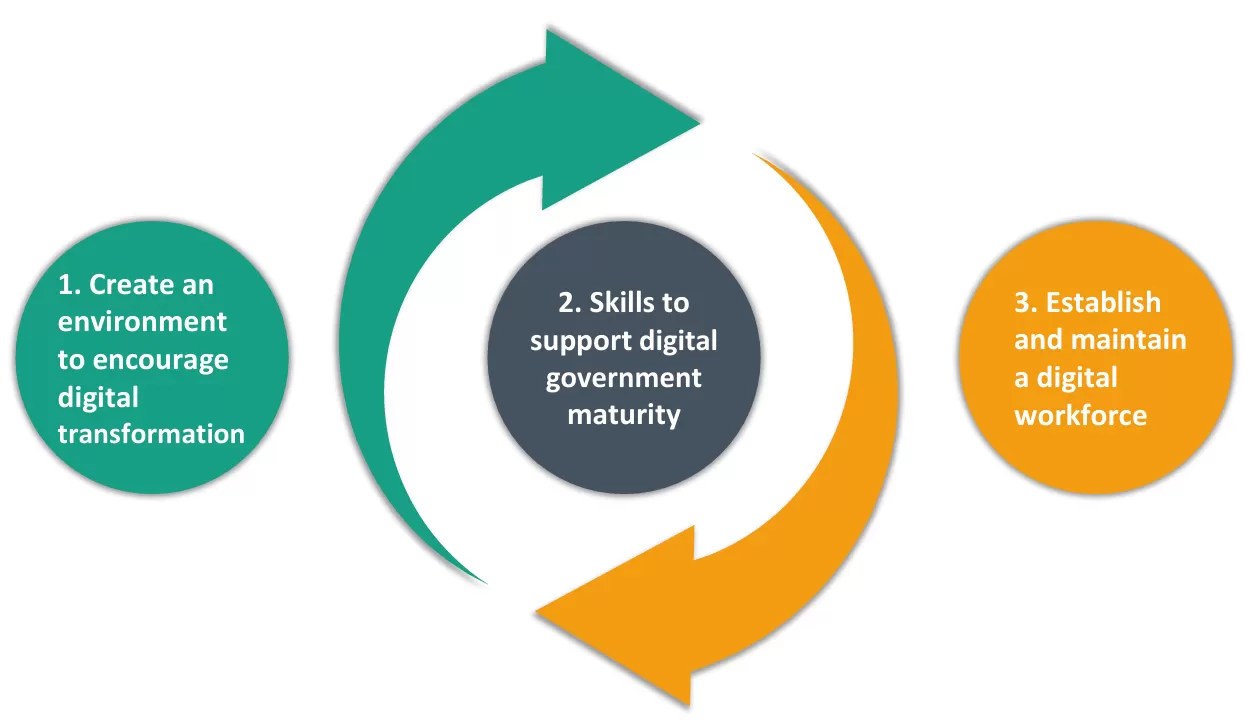
This paper presents the OECD’s framework for digital talent and skills, structured around those three imperatives, each grounded in real-world examples and practices from member and partner countries.
The Three Pillars of the Framework
Pillar 1: Create an environment to encourage digital transformation
Governments need more than strategies — they need workplaces where digital ways of working can thrive. That means:
Digital leadership that’s visible, user-centred, and empowering;
Organisational structures that enable multidisciplinary work and reduce hierarchy;
A learning culture where experimentation is safe and valued;
Tools and ways of working that support agility and delivery.
Pillar 2: Skills to support digital government maturity
Skills aren’t just about technical roles. The framework identifies that countries need to be mindful about the foundational “21st century skills” needed across society for people to thrive in the digital era and then identifies four categories of capability that rest on top:
User skills — digital basics for every public servant
Professional skills — the know-how for delivering digital services
Leadership skills — the ability to model and enable transformation
Each of those areas covers the detail needed to achieve a long-lasting and sustainable transformation and is grounded on raised expectations for all members of society and providing them with levels of digital competency that mean they fully thrive in our Internet-enabled world.
This has implications for government. And a critical observation in the framework is that digital government should not solely be the preserve of those in the digital, data and technology professions. Central to the framework is an expectation that governments should pursue a new baseline expectation for public sector workers to acquire a grounding in five core skills:
Recognising the potential of digital for transformation1
Pillar 3: Establish and maintain a digital workforce
It isn’t possible for governments to click their fingers and swap their existing workforce for a ‘digital’ one. And nor should they want to.
The answer to digital transformation is about having a workforce that is digital. There are important professions and career paths that need to be established but more importantly is creating an ongoing process that can enhance and equip everyone in the public sector to contribute to digital transformation.
This pillar focuses on how governments can:
Attract digital talent through flexible recruitment and employer branding;
Retain people by investing in culture, career progression, and equity;
Support growth through structured development, mentoring, and learning opportunities;
Build the systems to allocate skills effectively across teams and priorities.
The blurb
The rapid pace of technological advance and associated potential for the use of data have not only changed the way people live but also the way people work. This digital disruption hits all sectors, including the public sector, and this working paper emphasises pathways for developing a public sector workforce with the necessary skills to achieve successful digital transformation. It presents the OECD Framework for Digital Talent and Skills in the Public Sector, which highlights the need to create the right working environment, secure the right skills, and evolve the right workforce to support a progression from e-government to digital government.
When a public servant recognises the potential for digital transformation they: * identify, describe and analyse practical examples of digital transformation; * look at the status quo of existing processes and identify opportunities for digital transformation; * have a growing network of digital government practitioners to turn to for advice and challenge; * understand, and can challenge, whether new activity involving technology is consistent with wider strategic activity; * oversee and develop new digital, data or technology activity in ways that complement broader strategic activities * can ask relevant, informed, and challenging questions when they have oversight responsibility for digital, data and technology activity ↩︎
When a public servant understands users and their needs they: * champion and explain the value of user research and participate as part of user research exercises; * can identify the users affected by their area of work, and define the user needs their work meets; * can identify where their work interacts with, receives from, or hands off, to another part of government and recognises the importance of an end to end understanding of the user’s journey; * recognise the different channels and modalities involved in the provision of a service and can map the user’s journey, including associated internal steps; * understand the importance of tackling the digital divide and the priority, roadmap and strategy for accessibility, national connectivity and increasing 21st century skills in society ↩︎
When a public servant collaborates openly for iterative delivery they: * can explain the benefits of ‘working in the open’ and argue positively for an open by default approach * can implement participatory approaches to their area of work to genuinely include their users * understand the value of diverse, multi-disciplinary teams and expect to involve policy, delivery and operational colleagues to ensure a fully-rounded perspective on any given topic * can explain the benefits of an iterative approach to delivery * understand different phases of delivery (e.g., Discovery, Alpha, Beta, Live) and are clear about the benefits of researching, prototyping, testing and learning on an ongoing basis; * have an understanding of open source code and the community-based processes that support them * know where to find, and appraise, the suitability of common standards, components and patterns ↩︎
When a public servant is trustworthy in their use of data and technology they: * understand their responsibilities in the workplace around information security and data handling or processing * are confident in terms of digital security and clear about password policies * understand the legal requirements on them as individuals in terms of their handling of data to protect the privacy of citizens * are comfortable considering the ethical dimensions associated with the use of digital technologies or data, including knowledge of any relevant instruments such as Good Practice Principles * understand the support and activities associated with maintaining a reliable service * ensure that contracts with third party suppliers are consistent with the digital government agenda ↩︎
When a public servant knows about data-driven government they: * are aware of the individuals or organisations that are responsible for the data agenda * understand the priority, roadmap and strategy for taking the steps to establish a data-driven public sector * are familiar with the governance arrangements for access to and sharing of data * are confident in their legal and ethical obligations for the treatment of data * recognise opportunities for how interoperability, the Once Only Principle and access to transactional data can support the better design of services * adopt an empirical approach to the use of data for generating public value in terms of Anticipating and planning, Delivery, and Evaluation and Monitoring * understand the value of Open Government Data to government, and the wider ecosystem. ↩︎
Some recent AI headlines are genuinely frightening. But the questions AI raises go much further than whether one extinction forecast is right. What does Christianity give us for thinking about human dignity, embodiment, relationships, power, responsibility, formation and hope in an age of increasingly capable machines?
Britain still has a serious trust problem. But the OECD’s 2026 survey makes it much harder to treat public trust as one national score: institutions, experiences and demographic groups are moving in different directions.
Robert Jenrick calls excessive compassion “suicidal empathy”. But what happens if we turn the accusation towards Jesus: his costly nearness, outrageous grace, Cross and resurrection?
Burnham has a theory of political power and is making deliberate moves to strengthen the centre. But it seems much clearer about where power should sit than about how the state beneath it should operate.
To provide the best experiences, we use technologies like cookies to store and/or access device information. Consenting to these technologies will allow us to process data such as browsing behavior or unique IDs on this site. Not consenting or withdrawing consent, may adversely affect certain features and functions.
Functional
Always active
The technical storage or access is strictly necessary for the legitimate purpose of enabling the use of a specific service explicitly requested by the subscriber or user, or for the sole purpose of carrying out the transmission of a communication over an electronic communications network.
Preferences
The technical storage or access is necessary for the legitimate purpose of storing preferences that are not requested by the subscriber or user.
Statistics
The technical storage or access that is used exclusively for statistical purposes.The technical storage or access that is used exclusively for anonymous statistical purposes. Without a subpoena, voluntary compliance on the part of your Internet Service Provider, or additional records from a third party, information stored or retrieved for this purpose alone cannot usually be used to identify you.
Marketing
The technical storage or access is required to create user profiles to send advertising, or to track the user on a website or across several websites for similar marketing purposes.