
Somewhere between wondering whether Christians might pray more deliberately for the work of government and trying to make a year’s worth of devotionals readable on Instagram, I’ve found myself down a bit of a rabbit hole.
I’ve written before about an idea about praying for elected representatives, but that’s also led into a set of ideas beyond the people who hold office to the much wider work of government. Common Good wonders how might we pay more attention to the extraordinary variety of work involved in governing and serving the public? Not just politicians and headlines, but all those other things that keep our shared lives going, often without us giving them much thought.
I had in mind almanacs and whether there was a rhythm in the year. As the son of an Anglican vicar I had a good awareness of liturgical calendars. Though as we now hang out with non-denominational Vineyard types we don’t have much call for liturgy. And I hadn’t actually appreciated just how varied the world’s liturgical calendars are.
Anyway, I explored along those lines and settled on 52 weekly themes, which grew into 364 daily subjects, each with Scripture, a short reflection and five points for prayer.
With Advent approaching, and the start of a new devotional year on the horizon, I’ve been trying to get everything into shape for 2026/27. I’ll write a bit more about the hope behind this idea then but simply it’s to open up something of the wonder, love and appreciation God has for this enormous variety of people and work. And to allow something of that variety to breathe.
364 days of me and AI
There is no way that I could have made this on my own. Not remotely.
AI and I spent a great deal of time designing themes, choosing daily subjects and looking for suitable Bible passages. The Bible is so rich and varied on topics of governance and government that it was important to surface that variety, rather than lean on the same handful of verses about justice and leadership.
I was particularly excited to come across the Open Study Bible MCP, and then to meet David, its curator, at the London Missional.AI conference. The MCP gives AI tools access to biblical lexicons, study notes and cross-references, helping interrogate the words rather than simply accepting the first plausible-sounding connection.
Does that passage actually say what we’re claiming? Is there something better? Are we trying a bit too hard to make an ancient text address a modern government department? And, after all that, can we say something worthwhile in a short reflection and end with five things people might actually pray?
That represents an awful lot of prompting, questioning and iterating. These aren’t 364 reflections I wrote single-handedly, nor 364 responses to a one-line prompt. Those 364 days of material are the product of work supported by AI, with all the opportunities and limitations that implies. I don’t think using AI relieves me of responsibility for the passages we choose or what we say about them. Quite the opposite.
AI tools have also helped me build the Common Good website and bake in RSS and bolt on a progressive web app (PWA), so people can receive notifications when new material is available. I haven’t wired up email as yet though it’s on the backlog.
The art of the possible is still impressing me. Although, for all that acceleration, getting something out into the world is still sometimes painstakingly slow (I think this is a me problem and having too many ideas in flight in parallel).
Then having built Common Good, I wondered whether a small piece of it might occasionally appear on someone’s socials and make a difference to their day.
Twitter used to be good, and I used to be good at Twitter
I used to love Twitter. Ten or fifteen years ago, I spent far too much time there, not just scrolling but talking and engaging, making connections and finding opportunities. I’m pretty sure I wouldn’t have the career I’ve had without it.
These days my Twitter account sits dormant. X is now unashamedly interested in rewarding outrage and stoking fear and hate. It certainly isn’t somewhere I enjoy spending any time at all.
And there are plenty of alternatives. I’ve favoured Bluesky as my replacement, but I’m also on Mastodon, while my Meta footprint stretches back many years through Facebook and Instagram, with Threads added more recently.
But I’m not really on any of them in the way I once was. I’m certainly not particularly good at cultivating community in the way I once did.
And maybe I’ve just exchanged one kind of screen habit for another, involving rather more conversations with AI coding tools.
Still, my instincts are very web-based: an interconnected collection of things linking from one place to another. It’s one reason I’m stubbornly persisting with self-hosting this blog rather than collapsing it into Medium or Substack.
My default approach is to write something on my own site and share a link. One of the things social media is good for (or used to be good for), in my mind, is a way of pointing people towards things to be found elsewhere.
So that’s where my Common Good social posting experiment began. Snippets of the web content posted to the platforms to signpost back to the web content.
But that’s not necessarily in the interests of the platforms, many of which seem determined to keep our eyeballs exactly where they are. The Meta platforms in particular make linking elsewhere awkward. And the current architecture of X is a long way from what made Twitter special (indeed, you can’t post to X via API without paying so I’m not doing that).
So, rather than making a taster to entice somebody onto the website, what if the social version was the thing? If somebody sees a reflection about housing or environmental regulation, why shouldn’t they be able to read the passages and pray without going anywhere?
After all, the point is encouraging people in their prayer and reflection, not getting them to visit a website.
So for the next few weeks the experiments involve publishing the whole devotional natively: both Scripture passages, the reflection and all five prayer points.
Some days need more images than a platform can accommodate in a single post, and each platform behaves differently, so this isn’t simply a matter of distributing identical material everywhere.
Facebook and Instagram get a daily presentation of the complete material. Bluesky and Mastodon follow an all, reflect, prayer rhythm: the complete devotional in the morning, a chance to revisit the reflection at lunchtime, and an evening invitation to pray. Threads takes a slightly different approach.
All the accounts will actually need some followers before there’s much momentum so that’s going to need some thought (though perhaps you can help with that right now).
AI agents meet good old-fashioned APIs
When I started thinking about going beyond the website, my immediate assumption was AI agents to handle the social media side. Repackage the words, make the pictures, put everything in the right place. Job done.
And maybe they should be more powerfully left to their own devices than I’m allowing for. But I think the rabbit hole I’ve actually ended up in is more interesting.
Yes, AI has been enormously useful in adapting the materials, wiring things together and helping with consistency, ALT text and analytics. But the happy discovery has been OpenPost, a free and open-source project that handles much of the business of connecting accounts, scheduling posts and tracking what happens.
There’s still plenty to finish and test. The current scheduling relationship with the Web admin backend is still a bit more Heath Robinson than I hope it will be eventually.
But what a gift when people share useful software for others to build on. A big thank you to the OpenPost team.
The editorial side matters just as much. We took that problem to the recent FaithTech BUILD hackathon. Or rather, my Kingdom Democracy collaborator Dave and a small team did…I spent the weekend in bed poorly, which wasn’t how I’d imagined contributing.
Producing a year’s worth of material with AI is one thing, even with the help of the MCP. Making it actually good is another. So they worked on a process for reviewing and improving the daily materials, and carrying those improvements through to the website and social versions.
I’ve also got a trio of ideas about how the devotional might lead into deeper biblical study, engagement with public-policy research and calls to practical action. But those are subjects for another day.
A bucket for crabs
Ultimately that AI material is only a starting point. There’s a bigger idea that feels a bit ridiculous when written down: Common Good as a place where Christians who work in public service from around the world take a day’s topic to share their personal reflections and experiences from the work they actually know. My AI-assisted material gives people something to start with, but it can’t replace what they’ve actually seen and done.
I’m just very taken with the idea of what we might learn, and how much of God’s goodness we could celebrate, in hearing from “God’s servants who give their full time to governing” talking about the ordinary business of serving others from across the globe. Not because everything done in the name of government is good or above challenge, but because there is so much ordinary, unseen work worth paying attention to.
Finding 364 people who might contribute their own reflections to build on this AI-created starting point probably isn’t an impossible dream. But it’s still 364 people! Probably better to start with 52, one for each weekly theme, and see where that takes us. But that’s not for right now.
And that’s only one part of Kingdom Democracy, with its breathtaking conceit that Dave and I might have something to say about how the world is governed.
So in the face of that scale, I keep coming back to the tap on my brain and the tug on my heart towards something I love in God’s character: his interest in how we live and govern as a reflection of his Kingdom.
Massive. Impossible. Rather ridiculous.
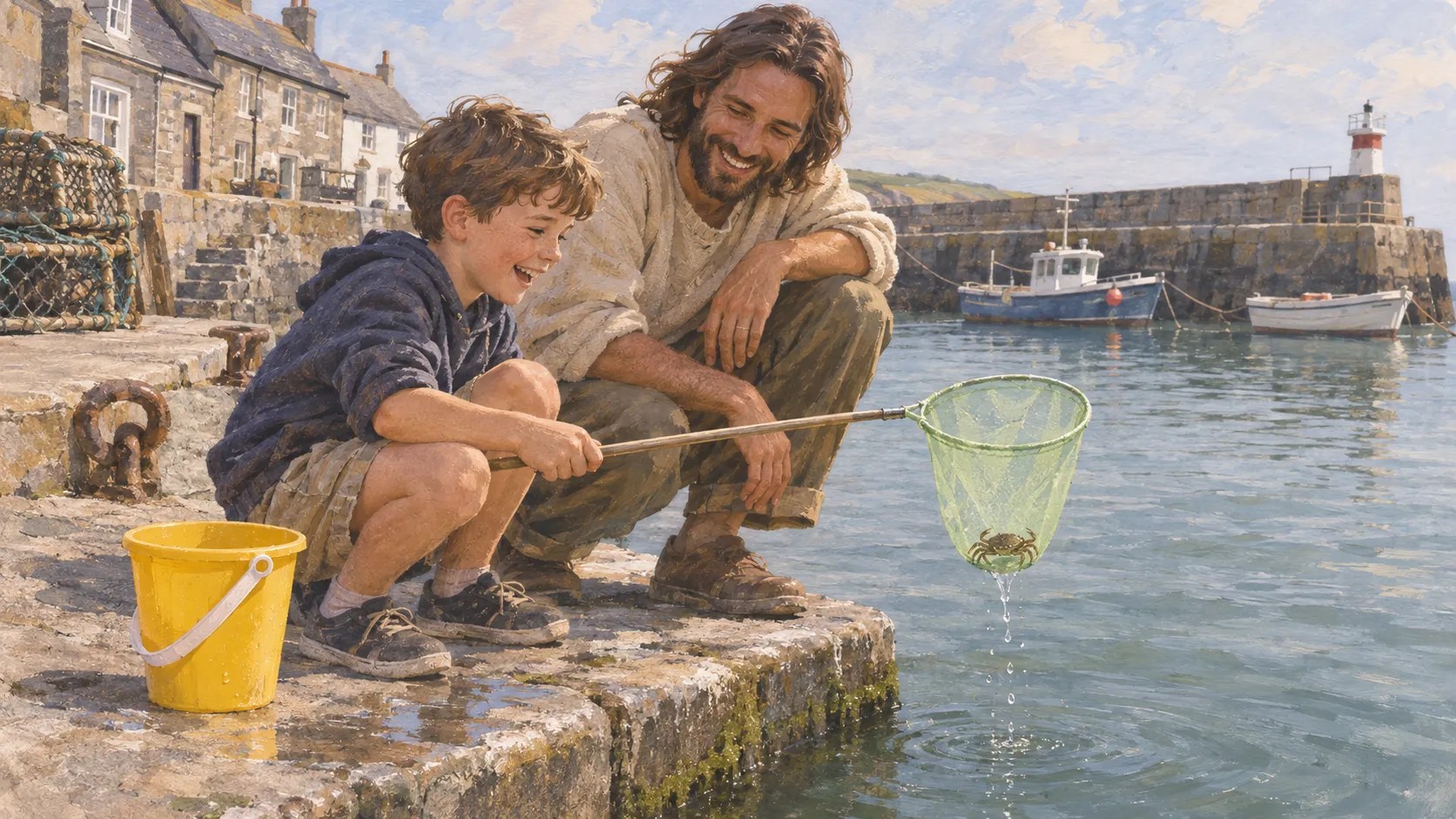
And that’s underlined by a wonderful picture that came to me one Sunday as I was being prayed for at the end of the service. Of a little boy, sat with Father God on a harbour wall, fishing for crabs with a bucket. Marvelling at all the life beneath the surface and getting ridiculously excited by whatever was caught. And this was set in contrast to the idea of commanding a fleet of trawlers setting out to empty the ocean.
The job isn’t to personally deliver on any enormous vision. It’s just about enjoying the next little thing with Father God, the audience of One, and maybe others will fancy joining in. But it doesn’t really matter either way because God and I, we’re having fun with this.
If you’d like to get involved
The new Common Good devotional year begins on 29 November 2026, the first Sunday of Advent. I’ll write more then about Common Good itself and the invitation to pray, hopefully with a view to finding some of those people who might fancy joining in.
I’d love to know what you make of the materials. Whether the social versions work for you, and especially where the Scripture choices, reflections or prayer points could be stronger or more relevant to the weeks they land on. One thing I’ve realised in writing this post is that Easter moving about means the ordering of weeks probably can’t just repeat from one year to the next (as it currently does but plenty of time to fix that).
During the hackathon we also developed a little way for people to explore the material and give feedback. You can start with the first day’s material from the 2025/26 cycle here.
It uses the earlier, shorter presentation of the devotional materials rather than the new full-length social formats, but that’s fine for what I’m hoping to learn. You can read the Scripture, reflection and prayer points, and tell me what’s helpful, what doesn’t quite work, or what I’ve missed.
Common Good — themes to prompts
2026/27 devotional cycle · 52 weekly themes · 364 daily prompts · Sunday to Saturday
The headings show the coming 2026/27 devotional year, but the links still open the earlier 2025/26 material for feedback. Choose a weekly theme, then a day, to read the earlier reflections and tell me what could be stronger. These are the historical /build versions, not the newer full-length social presentations.
Choose a theme to reveal its seven daily prompts.
01 — Refugees, Asylum and Sanctuary · Week of 29 November 2026
02 — Foreign Relations, Commonwealth Partnerships and International Aid · Week of 6 December 2026
03 — Climate Justice and Creation Care · Week of 13 December 2026
04 — Housing and Homelessness · Week of 20 December 2026
05 — The Incarnation and the Light for All Nations · Week of 27 December 2026
06 — Worship, Epiphany and Public Witness · Week of 3 January 2027
07 — Early Years and Primary Education · Week of 10 January 2027
08 — Secondary Education, SEND and Higher Learning · Week of 17 January 2027
09 — Youth Justice, Prevention and Restoration · Week of 24 January 2027
10 — Victim Support and Restorative Justice · Week of 31 January 2027
11 — Health and Healthcare Systems · Week of 7 February 2027
12 — Mental Health and Social Care · Week of 14 February 2027
13 — Welfare, Poverty and Family Support · Week of 21 February 2027
14 — Fostering, Adoption and Child Social Care · Week of 28 February 2027
15 — Migration, Borders and Human Dignity · Week of 7 March 2027
16 — Energy, Sustainability and Fuel Justice · Week of 14 March 2027
17 — Transport Infrastructure and Public Safety · Week of 21 March 2027
18 — Food Systems and Agriculture · Week of 28 March 2027
19 — Environment, Biodiversity and Flood Resilience · Week of 4 April 2027
20 — Industrial Strategy, Innovation and Worker Dignity · Week of 11 April 2027
21 — Housing, Placemaking and Urban Development · Week of 18 April 2027
22 — Trade, Supply Chains and Global Economic Justice · Week of 25 April 2027
23 — National Governance, Integrity and Stewardship of Resources · Week of 2 May 2027
24 — Local Government and Community Wealth · Week of 9 May 2027
25 — Elections, Civic Participation and Democratic Responsibility · Week of 16 May 2027
26 — Science, Research and Ethical Innovation · Week of 23 May 2027
27 — Disability, Inclusion and Accessibility in Public Life · Week of 30 May 2027
28 — Digital Transformation, Data and AI Governance · Week of 6 June 2027
29 — Media, Truth and Public Communication · Week of 13 June 2027
30 — Energy Security, Transition and the Common Good · Week of 20 June 2027
- Sunday — God’s Provision and Our Stewardship
- Monday — Balancing Security and Sustainability
- Tuesday — Innovation, Work, and the New Energy
- Wednesday — Addressing Energy Inequities
- Thursday — Environmental Stewardship in Energy Use
- Friday — Energy as a Tool for Peace
- Saturday — Trusting God for Energy Needs
31 — Emergency Services, Disaster Response and Mutual Aid · Week of 27 June 2027
32 — Charity, Volunteering and Civic Service · Week of 4 July 2027
33 — Faith, Religious Freedom and Public Pluralism · Week of 11 July 2027
34 — Defence, Cyber Resilience and Peacebuilding · Week of 18 July 2027
- Sunday — Praying for Just Defence
- Monday — Praying for Digital Resilience
- Tuesday — Praying for Peacekeepers
- Wednesday — Wisdom for Leaders in National Defense
- Thursday — Protecting the Vulnerable in Times of Conflict
- Friday — Praying for Peacemaking Partnerships
- Saturday — Trusting God in Times of Conflict
35 — Humanitarian Aid, Global Solidarity and Displacement · Week of 25 July 2027
36 — Taxation, Public Revenue and the Common Good · Week of 1 August 2027
37 — Equal Dignity, Justice and Belonging · Week of 8 August 2027
38 — Education Reform, Access and Lifelong Learning · Week of 15 August 2027
39 — Policing, Accountability and Community Trust · Week of 22 August 2027
- Sunday — Justice as a Reflection of God’s Character
- Monday — Training with Compassion and Wisdom
- Tuesday — Praying for Accountability and Transparency
- Wednesday — Building Police–Community Trust
- Thursday — Justice for the Marginalized
- Friday — Peacemaking and Restorative Justice
- Saturday — Trusting God for Justice
40 — Healthcare Equity, Research and Prevention · Week of 29 August 2027
41 — Mobility, Connectivity and Accessible Travel · Week of 5 September 2027
42 — Sustainable Development and Global Goals · Week of 12 September 2027
43 — Arts, Culture and Heritage · Week of 19 September 2027
44 — Sport, Recreation and Community Flourishing · Week of 26 September 2027
45 — Financial Regulation, Market Integrity and Public Trust · Week of 3 October 2027
46 — Housing Crisis, Affordability and Long-Term Reform · Week of 10 October 2027
47 — Faith, Public Service and the Vocation of Governing · Week of 17 October 2027
- Sunday — The Church as a Light in the Public Sphere
- Monday — Speaking Truth to Power
- Tuesday — Faithful Leadership in Public Office
- Wednesday — Advocating Justice and Compassion
- Thursday — Unity Among Christians in Public Life
- Friday — Faith and Ethical Governance
- Saturday — Trusting God’s Sovereignty in Governance
48 — Economic Policy, Inflation and Protection of the Vulnerable · Week of 24 October 2027
- Sunday — Wisdom in Economic Decision-Making
- Monday — Protecting the Vulnerable During Inflation
- Tuesday — Balancing Growth and Sustainability
- Wednesday — Faithful Stewardship of Public Finances
- Thursday — Combating Greed and Corruption
- Friday — Supporting Small Businesses and Entrepreneurs
- Saturday — Trusting God Amid Economic Uncertainty