Thoughts from the mind of Ben Welby

Category: Faith (Page 3 of 6)

‘What’s broken?’ – Mel Griggs

This entry is part 2 of 5 in the series Solutions for a Broken World (#fabworld)

This is a live blogged summary of what Mel Griggs said during his talk. It therefore doesn’t really hang together particularly well but might provide useful thoughts for you to jump off with.

Themes and issues for Mel to tackle.

Power and influence
The largely Christian world has seen its foundations are built on sand. Not spending time on money but trust and other things. Our problems are vast.

Greek and Italian governments fell, not by the electorate but by bond traders who forced interest rates so high that they had to step aside. Continue reading

Introduction: The Bishop of Selby

This entry is part 1 of 5 in the series Solutions for a Broken World (#fabworld)

He thinks the churches have been very silent
We’re in dangerous waters because money is very difficult but the easy strapline what would Jesus do is too simplistic.
In fact noone could predict Jesus himself and he got annoyed when he heard about people wrong.
Jesus usually replies when someone asks him about that issue over there, the woman in adultery, he asks for us to look at ourselves. Continue reading

My worlds collide

When I first wrote this it was relevant but I got overtaken by other events. Still, whilst it’s old news there’s no point it staying sat in my drafts.

There is no single theme for my blog. Most of the time there’s very little overlap so maybe I should be more focused and write in different places for different content. Irrespective of that, today is a bit different.

In the aftermath of this story I’ve read a lot and heard a lot of bluster in various media. As I’m a Christian who works in local government and have family connections to church in Bideford this particular story couldn’t be more relevant. Continue reading

John 21:15 – 25: Reinstating Peter

Conversations is starting a series on the life of Peter after Jesus’ death and over the next few months we’ll be exploring that.

Peter’s story begins on his home turf. Jesus arrives in a fishing village, he teaches, he meets some of the fishermen. They recognise him as the real deal. They follow.

This group of men includes the sons of Zebedee: James and John as well as another sibling pair – Andrew and Simon. At some point Simon’s becomes known as Peter. This change gains significance in Matthew 16 when Jesus asks his disciples ‘who do people say the Son of Man is?’. Peter gives the Sunday School gold star response: ‘You are the Christ, the Son of the living God’ and Jesus is delighted with Peter and says ‘On this rock I will build my church, and the gates of Hell will not prevail against it’. Simon’s name having become Peter is significant because Cephas/Petros means rock so Jesus is saying – ‘On this Peter I will build my church…’

So Peter is held in high regard by Jesus – he is also always mentioned first in the lists of the Twelve Apostles; he is present at more exclusive events such as the Transfiguration of Jesus; and he joins Jesus in walking on the water. John’s gospel gives Peter prominence – at the last supper he’s reluctant for Jesus to wash his feet and later names Peter as the disciple who cut off an ear when Jesus was arrested.

But the lowest point of Peter’s life (before Jesus’ death) is the denial. All four gospels detail how Peter was to deny Jesus three times before the cock crows. Continue reading

Thank you Dave

Last night was gutting. The leader of my church stepped down (in person, not via Twitter).

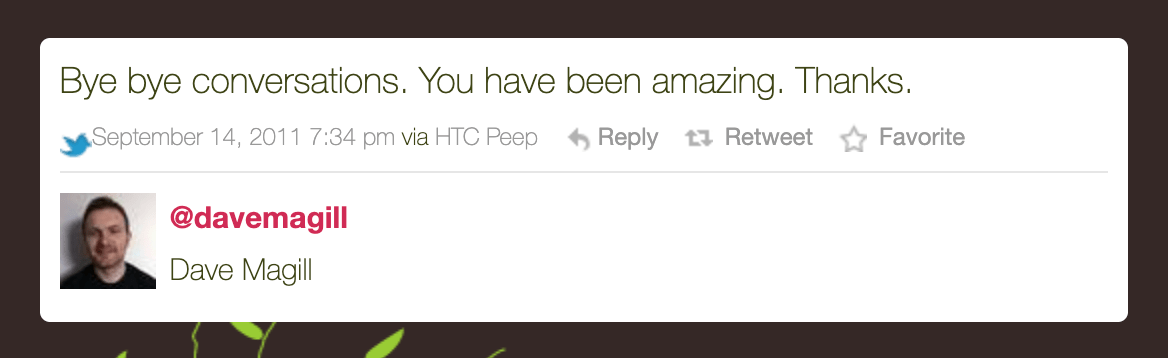
A tweet expressing gratitude, stating "Bye bye conversations. You have been amazing. Thanks." The tweet is from user @davemajgill.

For those of us involved with Conversations the last two weeks have been something of a blur. The pace at which decisions have been taken has left our community pretty shell-shocked as we look to the future.

That future includes Sally, Scott and I joining the Steering Team alongside Ben, B and Adam. And we’re committed to the same reasons that motivated Dave to kick Conversations off in the first place. His stepping down as leader doesn’t alter our vision statement.

Continue reading

Nehemiah: 1

These are my sermon notes from last night (Wednesday September 14th) shared with the community at Conversations. We’d had some difficult news in the preceding week relating to the future of the church and its leadership which makes our series on Nehemiah feel helpful and timely. You can read a bit more about that in my other post from today.

Let’s start with a bit of context:

The events of Nehemiah 1 take place 1,000 years after Moses and 400 years before Jesus.

Israel is in a desperate state – the Babylonians have conquered Jerusalem.

When they did that they deported almost everyone from the city – for 70 years Jerusalem was a ghost town. Potentially set to be forgotten to history.

The Jews began to make homes for themselves in Babylon. They settled and although they continued to follow God, they didn’t hold onto the idea of a Promised Land.

Some of them ended up in prominent places – Daniel, Shadrach, Meshach and Abed-Nego leaders in Babylon; Esther a Queen in the courts of a Persian king.

After those 70 years they had the opportunity to return home, to the Promised Land. Only 50,000 out of 2 or 3m returned. And that’s what the book of Ezra is about: rebuilding the temple and laying a spiritual foundation for Israel.

So, Nehemiah starts 15 years after the Book of Ezra ends, about 100 years after the first exiles return to the Promised Land and about 150 years after Jerusalem was destroyed. 

The walls are still ruined. 

They’d tried to rebuild them in Ezra 4:6-23 but had been stopped by their enemies. No-one thought this could be overcome so the walls lay in ruin and the people exposed to the danger of an unfortified city.

The book of Nehemiah is about a man who left a place of safety to put it all on the line to defend his city. To go to a place he was called to love, and to love it back into full strength and rude health. It cost him, but it glorified God and it transformed that city.

1 The words of Nehemiah son of Hakaliah:  In the month of Kislev in the twentieth year, while I was in the citadel of Susa, 2 Hanani, one of my brothers, came from Judah with some other men, and I questioned them about the Jewish remnant that had survived the exile, and also about Jerusalem.  3 They said to me, “Those who survived the exile and are back in the province are in great trouble and disgrace. The wall of Jerusalem is broken down, and its gates have been burned with fire.”

Nehemiah 1:1-3

Nehemiah hears about Jerusalem.

We find out he lives in the citadel – that means he’s important.

Nehemiah’s heart is in Jerusalem. He wants to know how the city and his people were doing. His heart was not on himself, but on others. Jerusalem was special to God, so it was special to Nehemiah too.

Continue reading

1 John:4 – Love Wins

1 John is a book that sets out some of the most fundamental characteristics of who God is and what being a Christian, part of His family, looks like.

And John’s quite blunt really. He sets it out quite clearly that God is holy, we are sinful and Jesus is our only hope.

Then he says that if you say you keep God’s commands, and don’t, then there’s a problem. And he says that if you’re more in love with the world than you are with God, then there’s a problem there too.

So we end up with an ideal of what we should be aiming for. John tells us about the need for right doctrines, right lifestyles and right relationships. It’s almost as though there’s something of a tick box exercise happening – tick all the boxes and well be called children of God and we’ll be like Him. If we live in Him then we won’t sin any more because Jesus has destroyed the work of the devil. So we should love one another and when we do that we know we’ve qualified for eternal life.

Sounds straightforward – the Eye-Spy of Christianity. An easy reference guide against which we can mark ourselves and score those around us.

Thankfully God isn’t sitting on a cloud waiting to smite us for cocking up but is desperate for a relationship with us that isn’t about legalism and transactionality. Continue reading

‘Stagnant and Lost’

Last week I had a week of holiday. Amongst a lot of doing very little it provided an opportunity to reflect on life ahead of Christine finishing her phd and starting work in Huddersfield at the start of May.

I effectively spend 12 hours of every weekday on the way to, or at work. And I realised that I wasn’t happy with either the commute, or my role. I was summing myself up in two words – stagnant and lost.

But on the back of this evening I’m reclaiming myself and rejecting those words.

I’ve just got home from a prayer meeting where it became apparent that God was gently mocking me. Five things neatly coincide in a way that has reset my thinking. Continue reading

>Christmas time, mistletoe and lies

>Every year there is a supposed attack on Christmas. Every year it’s another example of how our heritage is being dumbed down, hidden away and removed in the name of ‘political correctness’ and to avoid offending other faiths.

Often those allegations wheel out members of said faith communities to support the apparent slight being directed towards Jesus’ birth by saying they have no trouble with anybody talking about Christmas.

The most famous of all apparent attacks on a festival that isn’t important in and of itself  is Birmingham’s. We’ve all heard about how Christmas was rebranded as Winterval in an attempt to minimise any offence at all and to make sure that we of a faithful disposition knew that secularism has absolutely and completely done away with God from public discourse. I saw a member of General Synod appear on BBC Sunday Morning Live telling the nation all about it.

There’s just one snag with that story – that it isn’t the truth.

The truth is pretty ordinary. I quote from Mike Chubb, who was Head of Events in Birmingham at the time, and who himself is quoted by Andy Mabbett in a post titled ‘Winterval – the truth‘. Mike says

Quite simply, as Head of events at that time, we needed a vehicle which could cover the marketing of a whole season of events…Diwali (festival of Lights), Christmas lights switch on, BBC Children in Need, Aston Hall by Candlelight, Chinese New year, New Years eve etc. Also a season that included theatre shows and open air ice rink, Frankfurt open air Christmas market and the Christmas seasonal retail offer. Christmas, called Christmas! and its celebration, lay at the heart of Winterval.

So, just like a red coated Father Christmas and actually the linking of Christmas itself to an existing festival by the early church, the brand of Winterval was that. A brand. The success of that marketing campaign is clearly up for debate but the pervasive understanding that it was an attack on Christmas appears to have been whipped up by people who would identify themselves as speaking for me, other Christians and by extension as a representative of God.

And one of the characteristics of God is truth. This means that as Christians we stand in the middle of an epistemological minefield. On the one hand we talk about absolute truth whilst at the same time following a personal saviour who is absolutely relational. It’s why we find conflict with both ends of the philosophical spectrum. But our knowledge of truth and belief in the relevance and application of those truths is absolutely central to who we are.

One of the offending lights from Rochdale
(borrowed from the Daily Mail article)

So it’s always really distasteful when people lie in order to present a position that attacks other people and somehow ‘defends’ Christianity. Whether that is the individuals and councils who are behind the supposed slights or entire communities of people who aren’t like us the fact is that we’re not called to dominate. We’re not called to win. We’re not called to force people and coerce people into doing anything. In fact, The Church should stand at the front, clamouring in support of any attempt to hang Christmas decorations alongside those of Diwali and Eid because we’re called to love.

Not just a subtle, hidden and diluted love. No, our love is sacrificial. It’s loving beyond our own capabilities. It’s loving people for who they are, as they are, not for what they might become or how they can change. It’s unconditional. And so, it follows, that we would pour ourselves out to give value to other people and would, as the Daily Mail so generously suggests, want to shout ‘Merry Christmas EVERYBODY’ (except they seem to be suggesting that is A Bad Thing).

It does not follow that we would continue to spread untruths about Winterval. It does not follow that we would simply applaud Eric Pickles for suddenly giving us permission to forget about Christmas being about more than memorial. It does not follow that we would do anything other than demonstrate what it is to know Christ by making Him known in our lives as we challenge injustice, act with humility and hunger after mercy.

Let’s make more of a racket about how much we spend on Christmas. Not just focusing outside our church walls on ‘the world’ but about how much we invest into Christmas as The Church. The Advent Conspiracy put together this little video – £34 billion pounds gets spent on Christmas by Britain alone; £31 billion pounds could go a long way to solving malaria, feeding the world and providing clean water. Of course it’s not that simple but where would Jesus have us place our focus?

Today is St Nicholas Fayre in York, we’re opening our church during the day for ‘Thank God It’s Christmas’. The church, next to the Minster, will be open as a cafe with free drinks and cake on one of the busiest days of the year. We’ll also be having 12 minute long carol services every half hour through the day – a couple of songs and a brief talk about ‘why Christmas is important to me’. I’m involved with one of them. This wasn’t my theme, it could have been.

Tonight Conversations is celebrating Christmas. We’re holding a Party with A Purpose. The purpose? Providing ‘Christmas’ for families in York who otherwise won’t enjoy a turkey and trimmings, decorations or even presents. This is a city where 1 in 3 children live in poverty. That isn’t my theme either, although maybe it should have been.

One reason Christmas is important to me is because it’s a victory for humility. And that means it’s all about everybody else. And even that isn’t what I’ve prepared to talk about. Christmas, it is important…can we get on with telling people why please?

>Reinventing the wheel

>Sunday evening took this passage from Acts as its backdrop.

“They devoted themselves to the apostles’ teaching and to the fellowship, to the breaking of bread and to prayer. Everyone was filled with awe, and many wonders and miraculous signs were done by the apostles. All the believers were together and had everything in common. Selling their possessions and goods, they gave to anyone as he had need. Every day they continued to meet together in the temple courts. They broke bread in their homes and ate together with glad and sincere hearts, praising God and enjoying the favor of all the people. And the Lord added to their number daily those who were being saved…All the believers were one in heart and mind. No one claimed that any of his possessions was his own, but they shared everything they had. With great power the apostles continued to testify to the resurrection of the Lord Jesus, and much grace was upon them all. There were no needy persons among them. For from time to time those who owned lands or houses sold them, brought the money from the sales and put it at the apostles’ feet, and it was distributed to anyone as he had need. Joseph, a Levite from Cyprus, whom the apostles called Barnabas (which means Son of Encouragement), sold a field he owned and brought the money and put it at the apostles’ feet.”
Acts 2:42-47 and 4:32-37

That’s a revolutionary expression of community. That model of fellowship without borders was the hallmark of Jesus’ relationships. Not just with his disciples but with those society wouldn’t touch. The church of Acts are living with that same authenticity, vulnerability and generosity. They live grace, they are church. Those words aren’t theological constructs, they’re dynamic adjectives.

Their faith changed the world. Theirs a religion built around the service and love of those around them. Theirs a fundamentally relational pursuit of Jesus. Somewhere in the annals of history we dropped the ball. Religion became a dirty word bound up in ritual and show, dominated by fear, judgement and hypocrisy, not synonymous with the Gospel of ‘good news’ but seen to be something manipulative and controlling.

That’s not the true story. When the Archbishop of York was asked about his thoughts on Big Society he claimed the idea as a rebranding of what the church has been doing since its birth. For Sentamu (whose full article is well worth a read), Big Society’s just another name for the wheels which the church, alongside others, has consistently been involved with oiling for the last couple of thousand years.

Following the Spending Review the state is going to shrink, and there will be a reduction in services. There will be increasing needs and the church has the infrastructure, human resources and experience to contribute to finding solutions – the Church of England provides 23.2 million hours of voluntary service per month (and that’s just one chunk of The Church). More specific is Acts 4:35 an initiative of Archbishop Sentamu that provides a mechanism for giving money directly to others for specific purposes (in many ways it’s a local version of Kiva).

That’s great, as is our local commitment to The Besom. But we are absolutely wrong if we think that we’re the only people who care about kindling community and getting involved with transforming the lives around us. I might not enjoy the political rhetoric and cost-cutting reality that surrounds us at the moment but I do love the fact that there are lots of people who are exploring opportunities and experimenting with technology to give voice to the voiceless and support those who might otherwise fall through the gaps.

Sadly God’s hands and feet are conspicuous in their absence. This just doesn’t make sense. I can’t get my head around why we’re not round those tables, entering those debates and talking about the kind of compassion that hurts. The Acts model of community was radical 2,000 years ago and nothing has changed. What are we waiting for?

If it’s permission we’re looking for then the irony is that Acts 2 models of community are being spoken about and developed, probably by people completely oblivious to what’s written in the New Testament. Maybe it’s time we twigged that there’s universality to the wheel? God doesn’t always need us to start something, or for it to wear his brand or come under his ‘ownership’ for it to bring him glory and transform lives.

Is the Acts 2 challenge too hard given the busyness of life? I hear that, my daily commute sees me out of York for 12 hours a day. How do I foster meaningful community with those around me?Well, perhaps these four things which are already set up and focused on building relationship, fostering community and living generously can provide us with a platform inside church but also in dismantling the walls around our worshipping community.

The Big Lunch began life at The Eden Project a couple of years ago and encourages neighbours to spend the day with one another through street parties. Christine and I hosted one for our street in 2008 and it was brilliant (sadly we were both out of the country this year), instead of church on June 5th 2011 why don’t we shut up St Mike’s and break bread with our neighbours?

Flock Local was born at Glasgow’s Social Innovation Camp last June. The premise is pretty simple – directing the energy of a flash mob into an activity with a social purpose. The website provides a front end for listing local events and a mechanism for people to register, communicate and pitch in.

Street Bank exists to help people share what they’ve got with people in their locality. Sign up, list the skills you can offer your neighbours or the things you’ve got to lend or give away and see what happens.

Street Club overlaps the others and is a sophisticated approach to providing digital foundations to a local community. It’s designed to be a private online members club that revolves around ten key words – discuss, volunteer, ask, share, recommend, give, trade, play, save and party. There is something daunting about a resource this comprehensive but then it isn’t a website designed for individuals is it?

This week Conversations starts life in its latest venue (upstairs in The Graduate, formerly Varsity). I’m (justifiably) proud to belong to a community that hopefully looks like that early church. I hope we’re not just a community for ourselves but one that is committed to getting stuck into the world around us. We’re here to follow Jesus and that means pouring ourselves out for the people of York, til it hurts. Maybe signing up to a few websites can help?
« Older posts Newer posts »