I received an email today with details about the first stage of works that’s due to take place at the end of our street. The Chocolate Works development got planning permission way back in 2010 so it’s taken a long time to get to this point. Continue reading
Author: Benjamin Welby (Page 12 of 18)
I’m Benjamin Welby.
I live in Croydon with my wife and two children. I church at Croydon Vineyard. We’ve had season tickets for Bradford City since 2007. I’ve got degrees in History, Post-War Recovery and Public Administration and have spent the last 15+ years working at the intersection of digital transformation and good governance.
I began my career in local government, went on to help launch GOV.UK and most recently worked on defining global standards for digital government at the OECD. I'm currently currently co-authoring a book integrating biblical values with civic life, encouraging Christians to adopt a hope-filled, faith-inspired perspective on democracy and how we are governed.
I’m interested in too many things: being a good husband and father, following Jesus, the theology of governing well, a warm welcome for refugees and asylum seekers, that ‘digital’ leads to fair, inclusive and equitable transformation, exploring the world, League Two football, Pantomime, various England sports teams and Team GB…
Today we said goodbye to my Grandad. I shared a few words at the thanksgiving service in Taunton. The full details of which are available online.

I’ve added this post and the first on Alpha(local)gov to my series on ‘Local Government Digital Service‘ because it’s a helpful piece, reflecting an additional perspective from before joining GDS.
Two years ago I researched and wrote a business case to replace our content management system (CMS). This was shortly after BCCDIY and I argued that we should explore the opportunity to coopt partner with Hull’s excellent local talent to build something in the open that encouraged challenge and invited contribution. I lost (“we don’t want to be leaders”) and we picked a safer option. It was approved but something killed the project after I’d moved on in the graduate scheme rotation.
The need hasn’t gone away and on Tuesday I was invited to a meeting to identify tangible benefits for replacing the current CMS that would justify spending some money. Happily there’s talk of open standards and open source so that whilst buying something off a shelf wasn’t out of the question it might not be the automatic choice it once was.
And then that evening GOV.UK‘s beta launched and it brought me back to a piece I’d written last May about the local implications of alpha.gov.uk. Continue reading
Conversations is starting a series on the life of Peter after Jesus’ death and over the next few months we’ll be exploring that.
Peter’s story begins on his home turf. Jesus arrives in a fishing village, he teaches, he meets some of the fishermen. They recognise him as the real deal. They follow.
This group of men includes the sons of Zebedee: James and John as well as another sibling pair – Andrew and Simon. At some point Simon’s becomes known as Peter. This change gains significance in Matthew 16 when Jesus asks his disciples ‘who do people say the Son of Man is?’. Peter gives the Sunday School gold star response: ‘You are the Christ, the Son of the living God’ and Jesus is delighted with Peter and says ‘On this rock I will build my church, and the gates of Hell will not prevail against it’. Simon’s name having become Peter is significant because Cephas/Petros means rock so Jesus is saying – ‘On this Peter I will build my church…’
So Peter is held in high regard by Jesus – he is also always mentioned first in the lists of the Twelve Apostles; he is present at more exclusive events such as the Transfiguration of Jesus; and he joins Jesus in walking on the water. John’s gospel gives Peter prominence – at the last supper he’s reluctant for Jesus to wash his feet and later names Peter as the disciple who cut off an ear when Jesus was arrested.
But the lowest point of Peter’s life (before Jesus’ death) is the denial. All four gospels detail how Peter was to deny Jesus three times before the cock crows. Continue reading

The Guildhall, Hull
Last weekend I was asked by @WeLoveLocalGov if I could send them a sentence or two about why I love Local Gov for this post.
Absolutely, I thought; I know I love local government so surely I can send them 140 characters easily enough? Apparently not.
Whenever I sat down to muse and fire some letters in their direction it was really hard. And it wasn’t because I’d had one of those days where you’re reminded about the reasons why Local Gov is a frustrating place to work. No, it was because every time I sat down I remembered something else about why I love Local Gov.
And as the list got longer I thought the only way to do this justice is to blog.
So, why do I love Local Gov? Continue reading
Last night was gutting. The leader of my church stepped down (in person, not via Twitter).
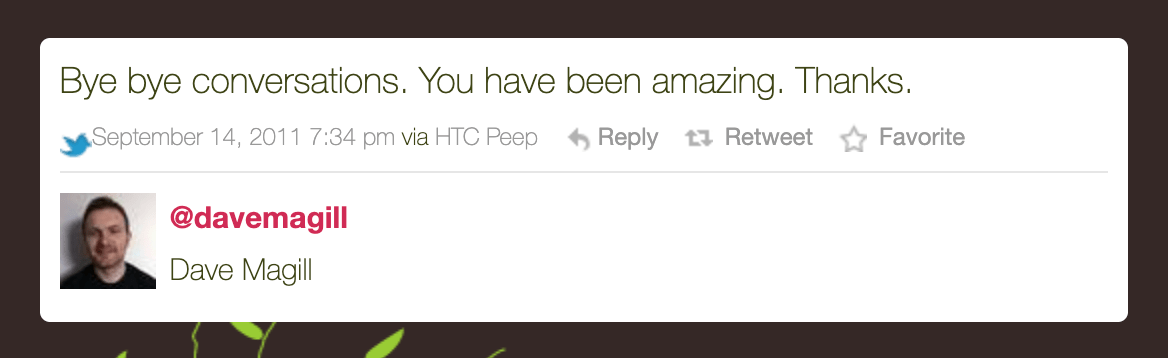
For those of us involved with Conversations the last two weeks have been something of a blur. The pace at which decisions have been taken has left our community pretty shell-shocked as we look to the future.
That future includes Sally, Scott and I joining the Steering Team alongside Ben, B and Adam. And we’re committed to the same reasons that motivated Dave to kick Conversations off in the first place. His stepping down as leader doesn’t alter our vision statement.
Continue readingThese are my sermon notes from last night (Wednesday September 14th) shared with the community at Conversations. We’d had some difficult news in the preceding week relating to the future of the church and its leadership which makes our series on Nehemiah feel helpful and timely. You can read a bit more about that in my other post from today.
Let’s start with a bit of context:
The events of Nehemiah 1 take place 1,000 years after Moses and 400 years before Jesus.
Israel is in a desperate state – the Babylonians have conquered Jerusalem.
When they did that they deported almost everyone from the city – for 70 years Jerusalem was a ghost town. Potentially set to be forgotten to history.
The Jews began to make homes for themselves in Babylon. They settled and although they continued to follow God, they didn’t hold onto the idea of a Promised Land.
Some of them ended up in prominent places – Daniel, Shadrach, Meshach and Abed-Nego leaders in Babylon; Esther a Queen in the courts of a Persian king.
After those 70 years they had the opportunity to return home, to the Promised Land. Only 50,000 out of 2 or 3m returned. And that’s what the book of Ezra is about: rebuilding the temple and laying a spiritual foundation for Israel.
So, Nehemiah starts 15 years after the Book of Ezra ends, about 100 years after the first exiles return to the Promised Land and about 150 years after Jerusalem was destroyed.
The walls are still ruined.
They’d tried to rebuild them in Ezra 4:6-23 but had been stopped by their enemies. No-one thought this could be overcome so the walls lay in ruin and the people exposed to the danger of an unfortified city.
The book of Nehemiah is about a man who left a place of safety to put it all on the line to defend his city. To go to a place he was called to love, and to love it back into full strength and rude health. It cost him, but it glorified God and it transformed that city.
1 The words of Nehemiah son of Hakaliah: In the month of Kislev in the twentieth year, while I was in the citadel of Susa, 2 Hanani, one of my brothers, came from Judah with some other men, and I questioned them about the Jewish remnant that had survived the exile, and also about Jerusalem. 3 They said to me, “Those who survived the exile and are back in the province are in great trouble and disgrace. The wall of Jerusalem is broken down, and its gates have been burned with fire.”
Nehemiah 1:1-3
Nehemiah hears about Jerusalem.
We find out he lives in the citadel – that means he’s important.
Nehemiah’s heart is in Jerusalem. He wants to know how the city and his people were doing. His heart was not on himself, but on others. Jerusalem was special to God, so it was special to Nehemiah too.
Continue reading
Glasswall by JanneM, on Flickr
My life is pretty transparent – if you Google me you’ll find a pretty lengthy trail of bits and pieces strewn across the internet (although I claim no connection at all to Beat The Rator, whatever that is).
I like freedom. I like openness. I like sharing.
If you follow me on Twitter, are my friend on Facebook or read this blog then there’s very little you won’t quickly learn about me. And I’m entirely comfortable with that.
But that’s not true for everybody. Continue reading
Just a quick thought.
Tomorrow the new Lord Mayor is getting installed and beforehand all 59 councillors have got the opportunity to press the flesh with the different directorates and service areas that make up Hull City Council in a marketplace event.
It’s a pretty good idea – councils are massive and it must be pretty daunting for any newly elected councillor to get a handle on what it is we do. And there’s value in taking a similar approach for communicating that breadth to the public (Walsall100 is a practical demonstration of that).
Anyway, in preparation for this event the different service areas and directorates have been pulling together briefing notes. In the Regeneration Directorate are two services: Economic Development & Regeneration and Physical Regeneration. And that covers a further 11 distinct areas of activity (BSF is part of Physical Regeneration). So putting together something brief that communicates everything from new schools to museums with European funding in between is not straight forward.
What we’ve ended up with is succinct and (hopefully) helpful in giving a nice overview of the directorate. It was the result of three different people working on it in their own spheres of influence – someone from the Economic Development & Regeneration wing, someone else from the Physical Regeneration arm and also the BSF team. In the end it’s come to us to wire the different bits together and produce a single document.
There’s no trouble in doing that but I yearn for a day when we might together, in our three separate offices, have been co-authoring a shared document and discussing the amends in real-time rather than the slightly delayed and cumbersome fashion that has seen slightly different versions of the same basic document flying about whilst different additions ping into inboxes; there is a better way to do this…
1 John is a book that sets out some of the most fundamental characteristics of who God is and what being a Christian, part of His family, looks like.
And John’s quite blunt really. He sets it out quite clearly that God is holy, we are sinful and Jesus is our only hope.
Then he says that if you say you keep God’s commands, and don’t, then there’s a problem. And he says that if you’re more in love with the world than you are with God, then there’s a problem there too.
So we end up with an ideal of what we should be aiming for. John tells us about the need for right doctrines, right lifestyles and right relationships. It’s almost as though there’s something of a tick box exercise happening – tick all the boxes and well be called children of God and we’ll be like Him. If we live in Him then we won’t sin any more because Jesus has destroyed the work of the devil. So we should love one another and when we do that we know we’ve qualified for eternal life.
Sounds straightforward – the Eye-Spy of Christianity. An easy reference guide against which we can mark ourselves and score those around us.
Thankfully God isn’t sitting on a cloud waiting to smite us for cocking up but is desperate for a relationship with us that isn’t about legalism and transactionality. Continue reading