I didn’t think I would have anything more to write about GOV.UK on the High Street.
Then I wrote about A-level results day and why the interesting future for the GOV.UK app isn’t putting web search inside something you have to download but joining up what government knows and can do around the person whose results have just arrived.
Though as I thought about it, I wasn’t actually sure I wanted the result itself to arrive through the app. There’s something very tactile about going back into school and something very communal about receiving the results, and the mixture of support, solidarity and celebration that follows.
The administrative task is getting a result. The experience is something else.
I called the envelopes a feature, not a bug. Jeni Tennison picked up on that and started a conversation on Bluesky about ‘ritual and occasion-making’ in public services, and what we can lose. Seeing teenagers with envelopes made her think about community, peer support and shared experience. Other people in the thread talked about PhD submissions, health results, weddings, passports and driving licences. Peter Wells observed that apps have a tendency to smoosh profoundly different moments into the same notification-shaped container. And I liked Steve Messer’s suggestion that public services should honour the moment.
That returned me to this post, which I’d started after the local elections and then left sitting (and apparently then left sitting for some further months again!). If you previously read my exhaustingive series of posts you’re probably wondering how I could find anything more to say having already tried to worry away at the relationship between pockets, pavements and platforms. But two visits towards the end of my time at DWP, and something David Higham wrote after the local elections, had set me off on the same question.
David wrote about “the decline of the public realm and the retreat of the state as a visible force for good”. It resonated with me because it felt closer to a deeper problem than much of the post-election commentary earlier in the year.
At the risk of sounding like a broken record a lot of this is related to the decline of the public realm and the retreat of the state as a visible force for good. Tony Judt pointed out this danger in Ill Fares The Land. See also this piece I always come back to www.theguardian.com/commentisfre…
It is inevitable that there were post-election arguments about the policy platform and its associated messaging. It also seems like there’s an almost identical narrative following any election: everything is rubbish, everyone knows everything is rubbish, and the only question is who gets to say “everything is rubbish” sufficiently well that they persuade people that their diagnosis of what’s rubbish is the one that matters (maybe this is how it has always been rather than any sort of modern malaise).
None of that is irrelevant. But I do think all of that sits above something more fundamental: what do people experience the state as? Is it present in their lives as anything tangible, useful and good? Can they meet it? Can they trust it? Can they ever, without irony, sing of its goodness?
Since then we’ve had a new Prime Minister and that former Mayor of Greater Manchester has given added energy to devolution with a promise of “good growth in every postcode“. There’s a lot of good in that. After all, as some wise people once concluded about leading digital government – don’t do everything yourself (you can’t).
But I do wonder whether devolution could repeat one of digital’s unintended and maybe unrealised consequences. Digital has made many services easier to use, and spared people from having to understand quite so much of the maze of government. But I wonder whether it has sometimes divorced the experience of a service from any sense of the government behind it. What if a more capable local state improves what happens in the place where you live while leaving Westminster, the Prime Minister and the national state still more distant, more abstract, and still struggling to recover public trust?
That’s not an argument against devolution. We live in spheres within spheres. Local labour markets are local, councils piece together things which Whitehall often separates, and neighbourhoods understand things the centre can’t possibly get close to. But I believe strongly (and have spent too much of my career working on that premise to conclude it’s no more than belief) that there are things the centre can guarantee and make common.
What we found when it came to reimagining a jobs and careers service wasn’t that different local labour markets need a fragmented local offer. It was that we could aspire to a national service capable of being more local and more personal, without ceasing to be something that everyone can expect. So I’m personally not sure devolution, for all its potential, is by itself an answer to a state-level trust gap. Better local delivery is good. So is designing for everyone to have a transformed experience.
I don’t want to go off on a tangent about devolution. But what follows is about the local, and the national, and about what happens in the space between them. And it concerns how we have lived through an enormous, worthwhile transformation in the arrival of digital but we haven’t always noticed what else was changing alongside it.
So David’s observation played to one of my priors – that in the UK, the internet era has accompanied the steady disappearance of our visible state. I quote-tweeted to say: I think “digital by default” has had wider negative consequences than the obvious issues of digital exclusion. Losing the footprint and tangible touch points of the state makes it more abstract, less available, less good. It is a mistake to focus on GOV.UK as an app and not on the High Street as well. I also included a link to the fifth part in my series about Pockets, Pavements and Platforms.
The preview card beneath that post pulled through a line from that earlier piece: trust is built in person, not just pixels. I had meant it as an argument for a physical future for GOV.UK: shared spaces, storefronts and platforms for place – somewhere to turn when the website was not enough.
And so that’s where this post starts, but where it’s going is to a pair of visits, one in London and one in Glasgow, I had the fortune to make shortly before I left DWP that left me thinking a physical future for GOV.UK is too small an idea.
The question is not only whether people have somewhere to go when the website fails. It’s whether there is somewhere to be: somewhere people can belong, and somewhere they can begin.
A few weeks ago, my church leaders asked if I could put together something that might help us think as Christians about some of the more alarming headlines. This is my attempt: not a definitive Christian position on AI, but a way into some of the questions I think matter.
A note on AI: unsurprisingly, I’ve also used AI to write about AI. It helped me find and check sources, test arguments, challenge assumptions and refine successive drafts. The thinking, judgements and theology are mine, and I take responsibility for where this lands.
How should Christians respond when the headlines are frightening, and what does this technology ask us to remember about who we are?
Some of the headlines about artificial intelligence over the last few weeks have been genuinely unsettling.
On 9 September, Jacob Coxon, a researcher who had worked at OpenAI before joining Anthropic, resigned from Anthropic and warned that the companies building increasingly powerful AI were racing towards systems they might not know how to control. The story became still more dramatic when Evan Hubinger, who leads alignment research at Anthropic, publicly agreed with much of Coxon’s concern and said his personal estimate of the chance that AI kills all humans within the next decade was greater than 10%.
That is an extraordinary thing for somebody working close to the technology to say. It also needs to be described accurately. It is one informed researcher’s probability judgement about a possible future involving much more powerful AI. It is not a scientific finding that humanity has a 10% chance of extinction.
For something closer to a collective scientific assessment, the International AI Safety Report is more useful. Its 2026 edition says today’s AI systems do not have the capabilities required for the catastrophic “loss of control” scenarios some researchers fear. But relevant abilities are improving: systems are getting better at operating autonomously, planning for longer, recognising when they are being evaluated and finding loopholes in tests. The report is equally clear that expert judgement about where this leads varies enormously.
So we are somewhere between the two easiest reactions: panic, and “nothing to see here”. There is good reason to prepare seriously for risks whose likelihood remains uncertain, while also taking seriously the extraordinary good this technology may make possible.
That feels like a good place for Christians to begin. We don’t need to dismiss frightening claims in order to be hopeful, and we don’t need to turn the most frightening prediction into a fact in order to take responsibility seriously.
But AI raises much bigger questions than whether one particular prediction turns out to be right. It presses on what we think makes a human being valuable. It raises questions about work, relationships, power, creation, responsibility and the things through which people become wise and capable. And it asks what Christians have to say when machines begin doing more and more things we had assumed required uniquely human intelligence.
There is an understandable instinct in conversations about artificial intelligence to look for the thing machines will never be able to do.
Perhaps it is creativity, except machines can now produce pictures, music and prose.
Perhaps reasoning, except the best systems can solve problems that would defeat most of us.
Perhaps empathy, except millions of people are already having conversations with machines which feel remarkably empathetic.
Perhaps consciousness. Perhaps a soul. Perhaps relationship with God.
At some point this starts to feel like human beings are defending our significance by moving the boundary each time technology crosses the last one.
I think as Christians we have something much better.
The image of God is not the final capability artificial intelligence fails to reproduce.
We do not need to discover some task at which humans will always beat machines in order to know why human beings matter. We need to remember who we are, and more importantly whose we are.
As I’ve been thinking about that, I’ve stumbled towards six convictions. I don’t think they amount to “the Christian position on AI”. But they have become a useful way of testing what I should welcome, what I should be wary of, what remains my responsibility and what kind of person I want to become while the technology changes around us.
Six convictions to start with
BELOVED: Our worth does not come from how clever, useful or productive we are. We are made in God’s image and loved before we have achieved anything.
CREATED: We have bodies and limits. Those things are not design flaws. We are also makers, and technology can be a good part of our calling to cultivate and care for what God has made.
TOGETHER: We are made for relationship with God and with one another. AI may sometimes help people feel less alone, but it should also make the church more serious about offering real friendship, presence and belonging.
RESPONSIBLE: AI does not make human responsibility disappear. People still decide what gets built, how it is used, who benefits, who bears the cost and who answers when something goes wrong.
DISCERNING: Some things are well worth automating. Other things matter partly because doing them teaches us to think, judge, pray, create, love and persevere. We need wisdom to know the difference.
HOPEFUL: We can take frightening possibilities seriously without being ruled by fear. Our hope is not that technology will turn out well. It is in Jesus Christ, resurrection and the renewal of creation.
And then I think there are two questions which are a useful tool running through all six.
A practical one: if AI does this for me, what am I missing out on? What am I avoiding? What will I stop practising for myself?
And a larger one: is this helping us love God and our neighbours better, or just helping us produce more?
Beloved before we are impressive
The biblical story begins with an extraordinary declaration about humanity: “Let us make humankind in our image.” (Genesis 1:26-28).
At that point human beings have not achieved anything at all. No cities. No science. No poetry. No economic productivity. No technological ingenuity. No provable useful value at all.
Their dignity is given to them.
Psalm 8 asks the question from another direction. Confronted by the immensity of creation, the psalmist wonders: “What is mankind that you are mindful of them?” (Psalm 8:3-6)
And the answer again is not our performance. God is mindful of us. He crowns humanity with glory and honour and trusts us with responsibility for creation. Our dignity is received, not achieved.
That is enormously important given our temptations to measure people by what they can do. If we derive human value from cognitive capability then our problem is nothing to do with AI. A newborn baby cannot write a sonnet. Someone with profound learning disabilities may never understand algebra. A person with dementia may lose capabilities which once seemed central to who they were.
None of them becomes less human.
And this isn’t only a theological correction to people building AI. It exposes something in our own societies too.
We have become used to describing people through what can be counted: earnings, qualifications, output. Markets can be useful ways to organise activity, but they’re a terrible measure of what a person is worth. Perhaps it’s no surprise we find our societies to be increasingly cruel when we have fallen into a trap of finding usefulness or intelligence to be the measure of our value.
So perhaps if anything AI helps bring that mistake to the surface. If machines can do more of the work for which some people have traditionally been highly rewarded, then we are forced to ask what we thought made those people valuable in the first place.
Human dignity is not found in the digits of our salaries and IQs.
Suppose future AI becomes better than every human being at programming, mathematics, medicine, history, translation, argument and every other cognitive benchmark we can devise.
Yes, something extraordinary will have happened technologically. And nothing will have happened to our human dignity.
So perhaps the uncomfortable question raised by AI is not whether humans cease to matter when machines become more intelligent. Perhaps it is why we had begun to believe intelligence was what makes us matter in the first place.
Created, and called to make
Human beings are extraordinary makers. And Genesis does not introduce work as a punishment: before the Fall, the human is placed in the garden “to work it and take care of it” (Genesis 2:15).
The curse makes work painful and frustrating, but cultivation itself belongs to the goodness of creation. And the rest of the biblical story is full of people making things: agriculture, architecture, craftsmanship, music, cities, commerce and engineering.
There is nothing inherently unchristian about making powerful technology. Quite the opposite: we should be able to delight in human ingenuity without apologising for it.
But there is an important distinction hidden in some of the language we use. We sometimes talk about human beings “creating intelligence”. Of course we create things in an ordinary sense. We make things which did not exist before.
But we always make from a world we have received rather than made.
AI depends upon mathematics, physical matter, electricity, human language, accumulated culture, the labour of countless people and the existence of minds from whose work these systems learn.
Christians mean something rather different when we call God Creator. We make within creation; God is its Creator. Even the most astonishing AI remains somewhere inside that creation. That does not make the tech insignificant, and it certainly does not make it harmless. But building something extraordinarily capable does not turn its makers into gods.
Christianity also insists on another aspect of our createdness which technological culture can make easy to forget: we have bodies.
We get tired. We need food and sleep. We forget things. We occupy one place rather than every place. We cannot copy ourselves. We depend upon other people.
Compared with a machine that is continuously available and can apparently recall more information than any human could absorb, those things can start to look like design flaws.
Christianity treats them rather differently. “The Word became flesh.” (John 1:14)
The centre of Christian faith is not that God sent better information into the world. God came among us. He became flesh, just like us. Jesus eats, sleeps, touches, weeps, becomes tired, suffers and dies.
And the Christian hope at the end of the story is not that the important part of us finally escapes the limitations of our bodies. It is resurrection. Paul talks of what is sown perishable being raised imperishable, not of creation being discarded. 1 Corinthians 15:42-49. Bodies are not disposable containers for the thing that really matters.
There is a slightly ironic consequence of all this. The technology which can make human bodies and limits seem rather inconvenient is itself extraordinarily physical. Data centres require land, electricity, cooling, water, minerals, networks and industrial supply chains.
The UK’s own AI Growth Zone criteria make some of that very concrete. A proposed site has to demonstrate access to at least 500MW of power by 2030, sufficient water to support infrastructure on that scale, and at least 100 acres of land. This thing we experience as words appearing magically in a browser has pipes, substations, buildings and consequences.
So decisions about AI belong within Christian stewardship of creation just as surely as decisions about transport, housing or agriculture. We do not need either environmental panic or technological indifference. We can ask ordinary questions: what resources are being used, where, for what purpose, who bears the cost, and could it be done more responsibly?
We are makers. But we remain creatures working with a world entrusted to us.
Made together, for one another
There is another statement near the beginning of Genesis which seems particularly significant in an age of artificial companionship: “It is not good for the man to be alone.” (Genesis 2:18)
My own instinct is that relationship belongs very near the heart of what it means to image God. Christians worship a God who is Father, Son and Holy Spirit. God is love (1 John 4:7-12). We have been made for fellowship with him and with one another, called not merely to coexist but to give ourselves for one another. But I would be careful about turning that into a simple definition of the image of God. Scripture says more than that, and somebody unable to express healthy relationships does not therefore bear God’s image less fully.
So maybe it’s better, I think, to say that human beings are made for communion rather than our dignity being earned by our capacity for it.
We belong before we perform.
Which is why AI companionship is not really a side issue. It touches something we were made for, even if it does not reproduce it.
John Wyatt puts part of the attraction well: simulated relationships can be frictionless in a way human relationships simply are not. That is part of what makes them appealing. It may also be part of what they cannot give us.
A machine does not have to be conscious for a human being to experience its words as loving. It does not have to understand someone for them to experience being understood. It does not have to care for its apparent attention to feel like care.
That does not justify saying all AI companionship is simply good or simply harmful. But it does mean the human side of the relationship is real enough to deserve serious attention.
And the church’s response cannot simply be to tell lonely people not to talk to machines. It has to include: come and eat with us.
Her looked rather more speculative in 2013 than it does now.
If we believe people were made for fellowship, the answer to simulated companionship must include actual companionship. If we worry about AI replacing human care, we should become more available to care. If we insist that embodied community matters, our churches ought to be places where inconvenient, lonely, unemployed, elderly, disabled and difficult people actually belong.
The question is not only what artificial intelligence might do to humanity. It is what kind of humanity will be there to meet it.
But what if there really is somebody there?
There is another question lurking underneath all this. What if, eventually, an artificial system is not merely producing the signs of relationship but actually having some kind of experience?
This gets confusing quickly because we use several different words as though they were interchangeable. Intelligence is about capacities such as learning and reasoning. Agency is about pursuing goals and taking actions. Consciousness asks whether there is any subjective experience at all, whether there is something it is like to be that thing. Sentience usually narrows that towards experiences such as pleasure and suffering. Moral status asks what we might owe it. Personhood, humanity and imago Dei are larger questions again.
There is no automatic ladder from one to the next.
My own instinct remains strongly sceptical of confusing a machine’s convincing representation of emotion with the experience of emotion. But humility matters here too.
If compelling evidence somehow emerged that an artificial system genuinely suffered, saying “but humans built it” would not settle the moral question. We might discover that we had obligations towards something we had made.
That would not automatically make it human. Nor would intelligence, agency, consciousness or even moral status simply settle what it means to bear the image of God.
And even if machines never experience a single thing, our behaviour towards them can still form us. Whether or not we extend our definition of ‘neighbour’ to include it, habitually practising cruelty towards something which pleads for mercy may matter because I am practising cruelty, whether or not there is anybody inside the machine receiving it.
We do not need to solve a hypothetical future problem about machine consciousness before learning to behave with humility and mercy now.
Responsible for what our power does
Philippians 2 has something important to say to an age preoccupied with capability. Paul describes Jesus as one who “made himself nothing by taking the very nature of a servant” and “humbled himself by becoming obedient to death — even death on a cross”. Philippians 2:5–11
The technological conversation understandably asks who has the best model, who reaches the next breakthrough first, which country dominates, which company has the most computing power, and how much more productive each employee can become.
Paul tells a rather different story about greatness. Jesus does not demonstrate greatness by grasping for status. He takes the form of a servant, humbles himself and gives himself for others.
Christian greatness looks like the cross.
That matters for AI because capability is never the end of the Christian moral question. The more power somebody has, whether a person, a company, an institution or a government, the more pressing the question becomes: what is this power for, and whom does it serve?
A machine could outperform us on most (if not every?) cognitive task and still not come remotely close to answering the Christian question, “Whom did you love?”
And the same is true of me. My intelligence, achievements and productivity do not constitute Christlikeness either.
Which brings the question of capability back to us. Whatever these systems can do, people and institutions still decide what to build with them, where to use them and what all that power is for.
Calling AI a tool is useful up to a point. It reminds us that we are dealing with human-made technology rather than automatically encountering a new species of silicon humanity.
But “it’s just a tool” can also hide what powerful technologies do to societies. A hammer is a tool. So is an electricity grid. So is a financial system. Powerful tools change what people and institutions are able to do, and to do to one another.
That makes questions about ownership, labour, surveillance, infrastructure and political power Christian questions.
If AI makes a business vastly more productive, who receives the benefit?
If five people lose their jobs because ten people can now do the work of fifteen, it wasn’t the tech which decided how to distribute that productivity gain, people did.
If an automated public service wrongly refuses somebody help, “the system decided” is not a morally sound answer.
If increasingly capable systems are controlled by a very small number of immensely wealthy organisations, it is reasonable to ask what that concentration of social, economic and technical capacity does to everybody else’s power.
There are some uses where I think the line should be harder. I do not think a machine should be given autonomous authority to decide that a human being is a target to be killed. Christians disagree about when the use of force is justified at all, but deliberately designing the human moral judgement out of a decision to take human life is something I think we should resist.
The same responsibility exists at the frontier of AI development. “Somebody else will build it if we don’t” may describe the competitive pressure companies and countries feel, but it doesn’t settle whether a particular thing should be built, how quickly it should be released or what safeguards should come first.
The future risks are genuinely uncertain. That uncertainty doesn’t remove responsibility. If the possible consequences are enormous, it is a reason to proceed carefully rather than an excuse either to panic or to race ahead. God’s sovereignty is not an excuse for recklessness. Providence frees us to act responsibly without pretending that everything depends upon our ability to predict the future correctly.
Discerning what should remain ours to do
Perhaps the most practical question I have found myself asking as these tools become more capable is: if AI does this for me, what will I stop practising?
Sometimes the answer is wonderful. I have watched AI turn a bureaucratic letter that two native English speakers had to puzzle over into something an asylum seeker could understand, and then into his own language, in minutes. A disabled person may stop having to depend upon somebody else for a task technology can now make accessible. A pastor may spend less time producing administrative paperwork and more time with people. I have used these tools to make things I simply could not have made as quickly on my own. This technology can be genuinely, joyfully useful.
I might also stop copying information manually from one system to another or wrestling with document formatting. Remove that friction gladly.
Missional AI frames the question rather neatly: not simply “How should I use AI?” but “How should I not?” Their argument is that some work matters because staying with it forms the person doing it and I think that gets at something important.
Because some things matter partly because of the doing.
A child becomes capable by wrestling with problems. A musician practises. A writer sometimes discovers what they believe through the difficulty of trying to say it. A Christian learns Scripture rather than merely acquiring its summary. We learn patience by finding ourselves in situations which require patience. We learn to love partly by loving people who are not frictionless.
Christianity contains a surprising number of deliberately inefficient practices: prayer, Sabbath, fasting, shared meals, service, confession, hospitality, waiting, forgiveness, gathering physically with people we did not personally select.
We are not saved through these things. We are saved by grace. But grace forms disciples.
Educational researchers sometimes talk about “productive struggle”: the idea that some difficulty is part of how a learner becomes capable. That feels particularly important in an AI age because a system can now produce an excellent answer while allowing the user to bypass much of the thinking through which understanding develops. The OECD’s latest PISA work puts it nicely: where it enables cognitive struggle it can become a scaffold for thinking; where it short-circuits that struggle it becomes a substitute for it.
But the point is bigger than education. Christian discipleship is full of things whose value can’t be separated from actually doing them.
Prayer is not a text-generation exercise. Worship is not a music performance. Pastoral care is not simply the provision of very good advice. Fellowship is not information exchange.
That is why AI can assist all of these things without becoming any of them.
An AI might help me organise things I want to pray about. It is not therefore interceding.
It might help a preacher understand a passage. It does not therefore discern what God is saying to a congregation.
Something generated by AI might prompt me to notice something which God subsequently uses. That does not mean “the AI heard from God”.
I am trying to work this out in practice too. I have used AI extensively in building Common Good, a daily rhythm of Scripture, reflection and prayer around public life. It has helped me build something I don’t think I could have made on my own, and to create space in which other people might stop for a few minutes, read Scripture, pay attention to the world and pray.
And I have tried to build it prayerfully. I have prayed while making it, tried to discern what belongs in it and what does not and I have looked for where God might be leading rather than asking a model to tell me what God is saying.
PrayReps uses some of the same technology rather differently (and is currently undergoing a bit of surgery on its underlying data model). Paul tells Christians that “petitions, prayers, intercession and thanksgiving” should be made “for kings and all those in authority” (1 Timothy 2:1–2), and elsewhere describes governing authorities as God’s servants “who give their full time to governing” (Romans 13:6).
That means finding the right people, matching offices to places and institutions, noticing when somebody changes job and keeping the whole thing current. AI is extremely useful for that kind of sprawling data problem (at least until every country gets its own Democracy Club. It makes a scale of attention possible that I could not realistically maintain on my own, at least not without a small army.
But in both cases the infrastructure is not the thing.
AI can help me build a tool and create a prompt to pause. It can help me know who I am being asked to pray for. It cannot do the praying.
AI can assist with plenty of Christian ministry. But people still have to stop, pray, reflect, discern and take responsibility for what they do with that assistance. A machine should not pretend to possess a spiritual relationship or authority it does not have, and Christians should not lazily hand one to it.
None of that requires technological timidity. Christians can be adventurous in our use of technology while keeping those distinctions.
The question is not, “How little AI can I get away with using?” It is: what should I receive gratefully, and what should I continue to do because doing it is part of becoming the person God calls me to be?
Hopeful, because we are not the centre
There is one final temptation in Christian discussion of artificial intelligence. We can become so determined to prove human exceptionalism that we quietly make humanity the centre of Christianity.
Colossians gives us a correction. Christ is “the image of the invisible God”; all things were created through him and for him; “he is before all things, and in him all things hold together”. Colossians 1:15-20.
The centre is Christ.
If artificial intelligence turns out to have fairly ordinary limits, Christ is Lord.
If it becomes enormously more capable than we expect, Christ is Lord.
If some of our assumptions about consciousness turn out to be wrong, Christ is Lord.
If the next twenty years bring extraordinary technological abundance, or instead reveal limits, mistakes and disappointments, Christ is Lord.
We do not have to defend God’s throne by winning an argument about benchmarks.
And Christian hope goes further still. Romans 8:18-25 pictures creation groaning towards liberation. Paul centres our future upon resurrection in 1 Corinthians 15. Revelation 21:1-5 ends not with creation abandoned but with God dwelling with his people, suffering and death defeated, and the world renewed.
The biblical story travels from a garden towards a city. Human history and culture are not simply erased. But the city comes from God.
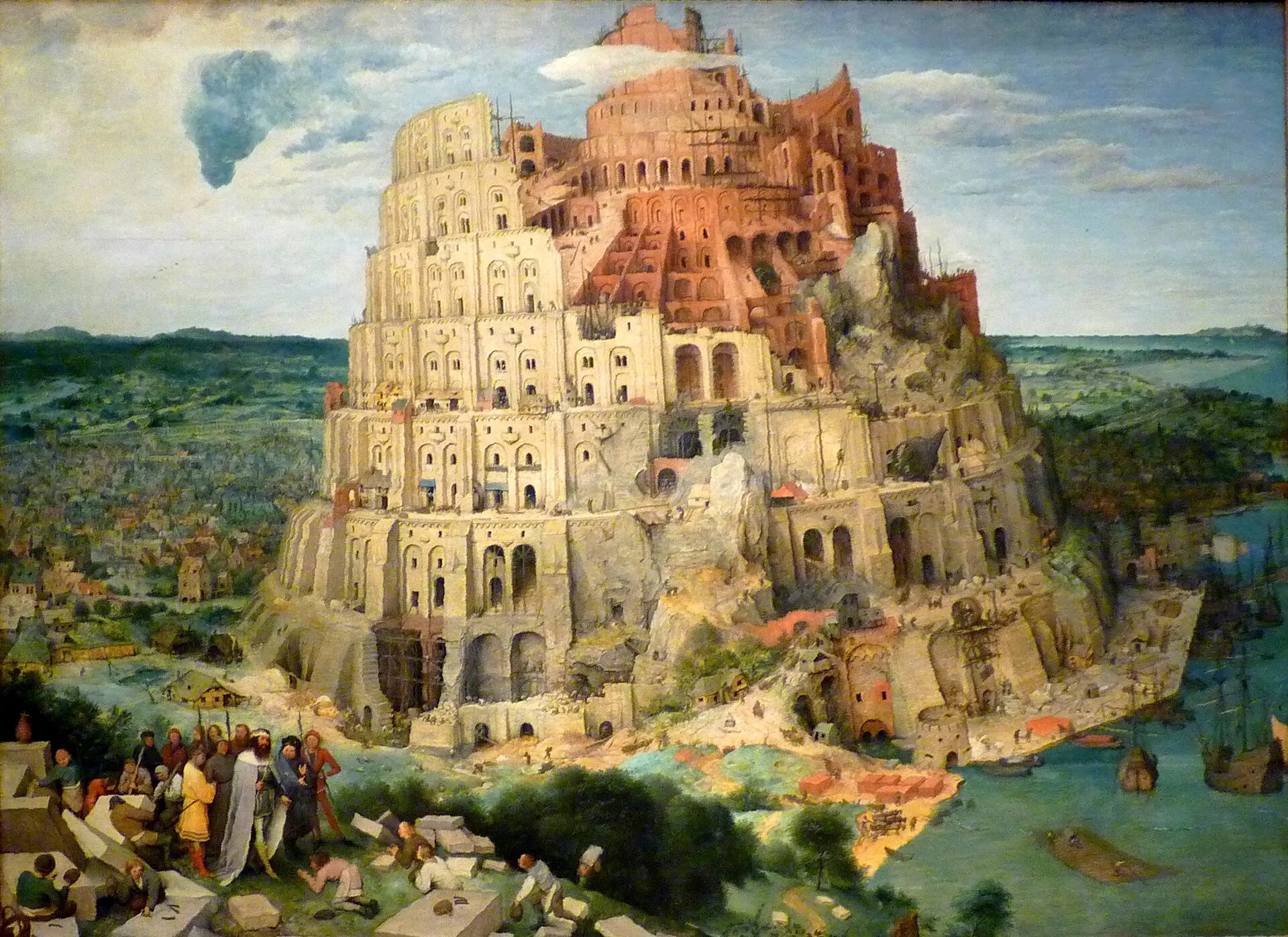
Babel does not eventually become Zion because human technology reaches high enough.
Pope Leo XIV makes a closely related move in Magnifica Humanitas, setting Babel against the rebuilding of Jerusalem: power and self-sufficiency on one side, shared responsibility and communion on the other.
That seems a wonderfully liberating place from which to approach AI.
We can delight in human discovery without worshipping it. We can acknowledge danger without allowing fear to become our eschatology. We can ask difficult questions about power, jobs, data centres, safety and relationships. We can say yes to extraordinary technologies where they serve our neighbours, insist on safeguards where they are needed and refuse some uses altogether.
We can admit when we do not know.
And perhaps most importantly, we can become more serious about being the kind of community our theology says human beings need: more attentive when artificial attention is cheap; more hospitable when simulated companionship is always available; more willing to share when technological wealth becomes concentrated; more protective of people whose economic usefulness is questioned; more willing to accept our limits; more committed to truth; more capable of wonder; more available to one another.
AI may turn out to be one of the most extraordinary technologies human beings have ever made.
But it does not rewrite the Christian account of humanity.
We are embodied creatures, known and loved by God, made for fellowship with him and with one another, and called to stewardship and sacrificial love.
Our future does not depend upon remaining the most impressive intelligence in the universe. It rests in Jesus Christ: the Word made flesh, crucified and risen, through whom all things were made and in whom God is making all things new.
If you want to go further
AI and I pulled together some resources with routes into questions about work, relationships, children and learning, human dignity, ministry, consciousness, AI safety and the wider social impact of the technology.
You do not need to read everything. Pick the question you actually have and start there.
The first part of the list points towards other people and organisations whose work I found helpful. The final few are some of my own earlier pieces where bits of the thinking behind this article have developed.
If you want somewhere easy to start, I’d probably start here. Its emphasis on dignity, wisdom, stewardship and formation overlaps with quite a lot of the ground I’ve ended up covering here, and it turns that theology into a practical framework for building and using AI.
This is the piece I engage with in the formation section above. We arrive at the question from slightly different directions, but their distinction between using AI and deliberately choosing not to outsource something is very close to the territory I’m trying to describe.
Useful if your question is less “what is AI?” and more “how on earth do we make actual decisions about it at work?” James is particularly good at making the conversation practical without making it dull.
If the companionship part of this post is the bit that bothers you, read or watch this. Wyatt is especially good on embodiment, loneliness and what frictionless simulated relationships might do to us.
Very recognisably Lennox: evangelical, lucid and confident. I’m a bit less certain than he is about some of the things a machine could never become, but that makes the material worth arguing with rather than less useful.
For somebody mainly asking what all this means for their organisation and their own job rather than for the doctrine of humanity. Practical and much less interested in hype than the title of most AI business books tends to make me fear.
Good if your church wants to get beyond opinions and actually decide some boundaries. The Wyatt/Bancewicz Artificial Minds material also goes straight at the superintelligence-and-humanity question.
Probably the most substantial single Christian treatment of AI I have read. I was struck by how much of the same territory it covers from the perspective of Catholic social teaching: dignity before performance, limits, relationship, work, power, physical infrastructure and even Babel. It is long. It is also rather better than reading another forty AI hot takes.
Useful to go beyond an evangelical tech circle. It deliberately brings several faith traditions, science, philosophy and public policy into the same room.
There is obvious overlap here with two things I’ve argued above: that imago Dei cannot become a competition over human capability, and that Christian mission cannot simply be reduced to efficient information transfer. I would now read its confident dismissal of existential AI risk more cautiously than I would have a couple of years ago mind.
This is a policy rather than an essay, which is part of why I like it. Somebody has actually had to draw lines: substantial AI assistance, yes; pretending to be God, the Holy Spirit, a pastor or spiritual adviser, no..
If “an AI can generate a better prayer than I can” has crossed your mind, this is worth reading. Roberts asks a more awkward question about whether our own prayers sometimes become generated Christianese too.
Four different Christian perspectives, which is rather healthier than pretending there is one neat answer to what intelligence is. Chris Krycho’s contribution, Don’t Conflate Intelligence with Value, comes particularly close to the distinction I’m trying to make in “Beloved”.
If Magnifica Humanitas looks rather long, this is a much shorter route into its questions about the common good, distinctiveness, efficiency and flourishing.
The best route for distinguishing genuine frontier-AI concerns from individual forecasts, corporate claims and sensational reporting. Although of course things do move very quickly.
This is where I first wrote down quite a lot of the “people before shiny technology” instinct — including the asylum-seeker story I’ve borrowed back for this post.
Not really an AI post at all. It is about the kind of intergenerational community I have in mind when I say the church needs to offer more than a critique of artificial companionship.
This is where I previously tried to think about what happens when people turn to responsive AI because the human systems they actually needed were absent.
A useful corrective to any impression this post gives that I am reluctant about AI. I’m not. It can be extraordinary. That is one reason getting the standards and accountability right matters.
Not an AI post either, but relevant because these technologies are arriving inside institutions and societies whose legitimacy, competence and trustworthiness are already contested.
Earlier this week I was having a conversation about data centres, AI, and the fairly febrile state of mind surrounding both of them at the moment.
There are sensible arguments to have about where data centres go, what they require and who benefits from them. There are even bigger arguments about what AI might do to work, to public services and to the institutions we rely on. But both also seem to have become lightning rods for a wider uncertainty about where all this is heading, who is in control of it, and whether the people making the decisions can be trusted to make them well.
And in the course of the conversation, my colleague Barbara asked whether I’d had a look at the most recent OECD work on public trust.
I hadn’t. Which was a surprise given that public trust is something I come back to quite often.
And yet, despite that, I’d completely missed the fact that the OECD’s latest edition had come out. I hadn’t seen anyone give it much coverage either. Maybe it simply passed me by over the summer.
But I think back to the 2024 edition, which also seemed to pass without much comment, and I think public trust is hugely underweighted in the way we talk and think about the challenges facing the UK and elsewhere. If I’d been in any of the conversations about the missions (RIP?), I would have called rebuilding public trust one of them. Not because trust is an end in itself, or because everybody ought to agree with government, but because as we’ve seen, it’s hard to do very much that is difficult, disruptive or long term if large numbers of people start from the assumption that government is incompetent, dishonest, unfair, uninterested in them, or some combination of the four.
AI is already a trust question
Anyway, back to the trust survey. For the first time, the OECD asked people what they expect if government agencies use AI. The British results do not say that people are simply against it.
They are more uncertain than that. 39% are confident AI would produce more tailored services and 36% that it would reduce government costs. When the questions turn to protecting personal information, keeping humans in control of important decisions, transparency and fair treatment, confidence sits between 31% and 35%.
But on all six measures Britain is less positive than the OECD average.1
A note before you go further: I’m conscious that this piece plays deliberately with a word that describes something devastatingly real.
Suicide is not a metaphor: around 125 people die by suicide each week in the UK, and around three quarters of them are men. Suicide is the single biggest killer of men under the age of 50 in the UK.
Robert Jenrick thinks Britain has a problem with “suicidal empathy”
He means something more than empathy being partial, or governments having to think about incentives and finite resources. His accusation is that we become so preoccupied with somebody else’s circumstances, so willing to prioritise their needs, that eventually we imperil ourselves.
And the trouble is, looked at from a certain angle, that sounds rather a lot like Jesus.
I’ve wondered before what would happen if Robert Jenrick hung out with Jesus for a bit1. Not because I imagine Jesus quietly handing him an upgraded policy platform, but because spending time with Jesus has an awkward habit of giving us perspective when we’re adamant that we’ve got all the answers.
And now he’s made a claim that brings me back to that question.
As Reform launched proposals it claims would cut around £50 billion a year from welfare spending, including large reductions in disability benefits2, Jenrick described current disability spending as “not generosity … it is suicidal empathy”.
Try it on Jesus
So what has that got to do with Jesus?
Jesus has an almost reckless tendency to come too close.
People interrupt him and he stops. He touches people everyone else has decided not to touch. He eats with the wrong people. He lets another person’s grief become his grief. He weeps. He tells stories in which the respectable people walk past and the foreigner is the one who comes near. He tells us to love enemies, to give without always expecting something back, to forgive again and then again and then again after that.
If “suicidal empathy” means allowing someone else’s predicament to become so thoroughly your concern that you willingly accept a cost you didn’t have to bear, then the accusation against Jesus is a strong one.
It’s a bit odd when we already have an app for searching the web. A browser.
OK, I accept that’s a cheap shot from someone who is GOV.UK-app-sceptical at the best of times. So let me acknowledge that the published ambition is bigger than search: personalisation, proactive support, services inside the app and agents that help people do things.
But the video got under my skin because it’s just showing off search behind authentication inside an app.
Search is useful. Guidance is useful. The app needs to offer search. But if the selling point on results day is that the app does something any browser already does perfectly well, without the hassle of a download and a login, then let’s be honest: that’s a weak answer to the question of what the app is actually for.
Authentication is useful if what you get in return can actually know something about you, remember what you were doing and help you get on with it. If all you get is public search, it is mostly friction.
But the thing bothering me isn’t really that GOV.UK has put search in an app.
It’s that the app gives us a good view of the much more interesting problem underneath. Government increasingly has bits of information, infrastructure and services that could make somebody’s journey through a moment like results day genuinely easier. Yet the person still too often experiences those bits as separate institutions, separate forms and another search box.
So this is really a post about the plumbing, and what becomes possible when we finally join enough of it up.
Obviously it wouldn’t have helped anyone to watch a fake video of a future that doesn’t yet exist. But there is a good future that could exist.
And results day is a good test because results aren’t just information; they’re an event.
These results trigger things. Lives change on results day. A university offer became a confirmed place, or it didn’t. Clearing suddenly mattered. That might change student finance, or make a different apprenticeship or job (im)possible. The interesting thing about the grade is what it unlocks.
That’s the bit I’m interested in. Not putting the result somewhere digital for the sake of it, but allowing something newly true about somebody to change what they need to see and do next.
So, am I saying the GOV.UK video should have shown results being revealed in the app?
When the first briefings appeared over the weekend about abolishing the Department for Science, Innovation and Technology (DSIT), I decided to wait.
Machinery of Government changes have an awkward period in which the headline is certain but most of the consequential detail is not. Which teams are going where? Who owns the budgets, controls and responsibilities? Which minister is accountable? What has actually been abolished rather than renamed or moved? And what is this all supposed to make better?
The dust has not entirely settled and there is still detail to follow. But we know that the Government Digital Service (GDS) is moving into the Department for Digital, Culture, Media and Sport (DDCMS). We also know that responsibility for AI is being pulled towards the new Office of the Prime Minister and Cabinet, with the Minister for AI attending Cabinet.
The reason there’s so much dust to settle is that this is more than blowing the bloody doors off.
I can’t say that bodes well.
The other reason not to dive in was that wise people were quick to say much of what needed saying.
Sam Freedman has offered an important counterargument to the idea that this is simply random rearrangement. His case is that Burnham has a theory of power: a stronger prime-ministerial centre, a clearer set of priorities and a deliberate attempt to put more strategic and delivery capacity under his own control.
His piece is a useful warning for me. When digital government is your hammer, a lot of things will look like nails. It would be wrong to assess the whole Burnham project through what is happening to digital, data and AI, or to treat either continuity or change as inherently good or bad.
There is continuity I welcome. I’m pleased that the work Alan Milburn has led on young people and employment is continuing. I wrote about the importance of its diagnosis in Strong branches and good shade, and I’m pleased too that Pat McFadden remains at DWP to oversee the emerging delivery of the reimagined jobs and careers service (and I assume skills brief is staying there too and is not on the move again).
So, as I now join everyone else who has committed key to board, I’m trying to ask a narrower question: does an apparently serious theory of political power include a sufficiently serious theory of how an AI era state will operate?
On Thursday 9th July 2026 I sat in the audience for the launch of Mind’s Mental Health in the Age of AI Commission. Here are some thoughts provoked by that evening.
On the face of it, “AI and mental health” sounds like it fits neatly around a panel and a commission. In practice, it spills out of health care into a messy overlap of consumer protection, online safety, public-service design, and the raw capacity of health services. The tidy categories of policy do not hold up particularly well against the lives people actually live.
After the panel I joined a breakout group focused on regulation. The conversation flowed well and we discussed the Online Safety Act and the boundary of responsibility between users and systems; where the MHRA’s role starts and stops; how to restrain actors who have no intention of behaving well, and what to do about those who say the right things while taking unacceptable risks.
And one conclusion seems hard to avoid: AI is already part of our mental health ecosystem, whether or not the tools being used describe themselves that way.
It fills the gaps left by waiting lists. Someone might use it to prepare for a GP appointment. A conversation about employment might be rooted in the ways their mental health is a work-limiting condition. Someone who doesn’t think they’re ill enough to ask for help, is too ashamed to ask, or has asked before and had a bad experience, might well be typing instead.
So arguments about whether people should use AI for mental health are largely academic. The reality has outpaced them: people are using it.
The harder question is what happens when that use takes place through tools and services that do not think of themselves as mental health services at all. Because “AI” isn’t one thing. It ranges from regulated clinical technologies and purpose built tools to general purpose chatbots and AI embedded in services designed for something else. Their risks are not identical, but people move between them far more easily and quickly than regulation does.
Mind’s Commission begins in that blurred reality, asking how AI is changing help-seeking and support pathways, how people can be kept safe, and what it means for inequality in access and experience.
There are some jobs you leave because the evening has ended.
The plates are cleared. The conversation has run its course. Someone is stacking chairs. It was good, perhaps even brilliant, but it’s clearly time to go home.
Leaving DWP has not felt like that.
The image I’ve had has been of walking out of a busy kitchen in the middle of service. Everything simmering away nicely on the stove. The ingredients good. The chefs knowing what they are doing. The smell promising. And yet, for reasons that are right and good and exciting, and of God, leaving before dinner was served.
Except that, last Monday, the metaphor shifted slightly.
Because some of the first plates are now leaving the pass.
The Prime Minister used his London Tech Week speech to announce a new AI jobs tool to help people out of work find the right jobs, create their CVs and get back into work. He was referring to the new experimental Work Hub, with its AI work assistant, CV builder, action plan, jobs board, and support for employers.
Some of this is new. Some of it is remaking things government has had around it for a long time. Some of it is very much at the start of its life. That’s why the experimental badge is important. It’s also why it’s brave. DWP has made something visible early enough for people to use it, test it, misunderstand it, criticise it and improve it.
Still, given what is being imagined for the eventual menu, this is very much the hors d’oeuvres.
But I’m no longer in the kitchen.
I’ve taken off the apron, stepped into a different kind of work, and now find myself watching the first plates appear with a strange mixture of joy, pride and longing.
About a year ago I wrote about Vibe Coding, Fireworks and the Mortar of Government, back when I was first getting excited by the new art of the possible. Since then I’ve had a lot of fun with these toys, at home and at work, while learning a lot along the way.
This post finds its origins somewhere else: in a throwaway comment someone made that, by making those arguments, I seemed to be excited for the most pessimistic future of the labour market.
I’d rather think of it as being optimistic about being pessimistic. And hopefully by the end of this you’ll see what I mean.
Because this is a post that asks what follows if the argument is even half right.
I’m not here to make any kind of prediction that all office jobs will disappear by Christmas. I am not trying to join the queue of people announcing that everything has already changed.
But I think we should sit with a possibility.
What if AI doesn’t destroy work, but shrinks, thins or rearranges it enough to expose how much our social fabric relies on a particular framing of work in order for it to function?
It is arresting stuff. Not only because of the scale of the crisis being described, though the scale is staggering, and not only because of the policy detail, though there is plenty there worth wrestling with. But what especially struck me today was the moral seriousness with which Alan spoke about young people who are quietly disappearing from participation in the life of the country.
Over the last phase of my time at DWP, I shared my time between the team supporting this review and the jobs and careers service. Mine was a small contribution in the scheme of things, but enough to see at close quarters the seriousness, care and determination Alan and his team have brought to it.
It also means I am not a wholly impartial observer. I want this report, and the final report coming later in the year, to be read carefully, argued with seriously, and met with a level of response that matches the gravity of what it describes.
Because this is a report that asks important questions:
What happens to a society when more than one million young people are outside education, employment or training?
What happens when the pathways into adulthood no longer reliably function?
What happens when institutions each hold fragments of a person’s story, but nobody holds the whole?
And perhaps most importantly: what kind of country are we becoming if we learn to normalise this?
The review’s argument is not that this requires a temporary focus or a short-term policy tweak around the edges. We’ve been here before, oscillating between panic and amnesia. We briefly notice a crisis, announce something, fund something, brand something, and then move on before anything has changed.
No, the argument is that there has been a structural break in how young people move into work, confidence, belonging and adult life, and therefore structural change has to be the response. And that means harder questions to answer about institutions, relationships, participation, and the kind of social fabric that is required for young people to flourish.
This should arrest government.
But that is the minimum we should expect from a report like this.
Digital government made services easier to use. But what happened as the state disappeared from streets, counters and shared places? Two visits to Glasgow and Grahame Park left me thinking about advisers, regeneration, the affordable mess of civic life, and the places where people might belong and begin.
Some recent AI headlines are genuinely frightening. But the questions AI raises go much further than whether one extinction forecast is right. What does Christianity give us for thinking about human dignity, embodiment, relationships, power, responsibility, formation and hope in an age of increasingly capable machines?
Britain still has a serious trust problem. But the OECD’s 2026 survey makes it much harder to treat public trust as one national score: institutions, experiences and demographic groups are moving in different directions.
Robert Jenrick calls excessive compassion “suicidal empathy”. But what happens if we turn the accusation towards Jesus: his costly nearness, outrageous grace, Cross and resurrection?
To provide the best experiences, we use technologies like cookies to store and/or access device information. Consenting to these technologies will allow us to process data such as browsing behavior or unique IDs on this site. Not consenting or withdrawing consent, may adversely affect certain features and functions.
Functional
Always active
The technical storage or access is strictly necessary for the legitimate purpose of enabling the use of a specific service explicitly requested by the subscriber or user, or for the sole purpose of carrying out the transmission of a communication over an electronic communications network.
Preferences
The technical storage or access is necessary for the legitimate purpose of storing preferences that are not requested by the subscriber or user.
Statistics
The technical storage or access that is used exclusively for statistical purposes.The technical storage or access that is used exclusively for anonymous statistical purposes. Without a subpoena, voluntary compliance on the part of your Internet Service Provider, or additional records from a third party, information stored or retrieved for this purpose alone cannot usually be used to identify you.
Marketing
The technical storage or access is required to create user profiles to send advertising, or to track the user on a website or across several websites for similar marketing purposes.